unique towns
A walk in Budapest
by tb on Dec.10, 2011, under Destinations, Hungary, unique towns
![IMG_4014 [640x480]](http://toptravelleads.com/wp-content/uploads/2011/12/IMG_4014-640x480.jpg)
Assuming you will fly to Budapest but will not spend any time there, or you will arrive by train for example from Prague but will get off at Vac, and will be staying in Vac as described in the previous post, following is just a suggestion on a possible day trip and a walk in Budapest you can do to see the key sites of the city. Needless to say, a single day trip is not going to give justice to any kind of in depth experience but you can at least get a good feel for the city which is better than not-having dropped in at all.
From Vac the most convenient way to get to downtown of Budapest is with a suburban train running every 10 to 15 minutes from Estergom to Nyugati railway station, also known as the West Station, the final station of the suburban line ending in north-central part of Pest.
Nyugati is a convenient starting point for a walk that will take you past several key landmarks to the Danube, then across the Szechenyi Chain Bridge to the west bank and uphill to the Buda Castle Hill and its Old Town dominant landmarks, the Matthias Church and the viewing platform of Fishermen’s Bastion, the best place in Budapest to savor the skyline of the city, most well-known for the finest views across the Danube at the impressive edifice of the Parliament. But being at the Buda Castle Hill also offers nice views in the opposite direction, toward the residential districts of Buda Hills, opportunity to stroll the pleasant alleys of the Old Town, visit the Royal Palace, and a number of good museums.
While on such a short visit you will have hardly enough time to sample all of Budapest’s history and cultural legacy of the Magyars, Romans, Mongols, Turks, Habsburgs or Communists, with some small detours you could see at least one representation of Budapest’s most diverse architectural styles, from the Roman period to baroque, neo-Classical as well as Art Nouveau eras.
From the Nyugati station walk south to Terez boulevard, a major city artery. Walk some 1000 yards until you reach Andrassy Way. Those with ample time could turn left here and walk along Andrassy all the way to the City Park first. Along this route you can see number of prominent attractions including the Museum of Fine Arts.
With less time or to keep the walk to some six miles total, turn right on Andrassy, walk past the neo-Renaissance Budapest Opera until you reach a large intersection where you will turn right. Some 400 feet on your left you will see the monumental neo-Classical structure of St. Stephen’s Basilica. In front of its front entrance starts a nice pedestrian zone, where a wide plaza in front of the church leads into Zrinji ucta, a narrow pedestrian street lined with cafes and restaurants that will bring you all the way to Roosevelt park on the bank of the Danube.
You can cross the park in front of the luxury Four Season’s Gresham Palace Hotel, a striking Art Nouveau landmark which is worth a close
look.
Beyond the park you enter the Szechenyi Chain Bridge, a mid-19 century structure and the first bridge to span the Danube and connect Buda with Pest, definitely one of city’s most recognized landmarks. Crossing the bridge allows for fine photos up the Danube looking north towards the neo-Gothic and neo-Renaissance Parliament and the bridges beyond.
Once on the Buda side of the river you can opt for taking the funicular railway up to the Castle Hill or pick the slower option which is to walk up through the wooded hillside. Walking up allows for a bit better appreciation of the elevation of the castle town on your way to the actual and final destination of the whole walk, the neo-Gothic Matthias Church and the wonderful viewpoint at the Fisherman’s Bastion.
Colombia Travel: Cartagena on Foot
by Alexandra Rosen on Sep.15, 2011, under Colombia, History & Culture, Travels in Colombia, Travels with Alexandra and Donald, unique towns
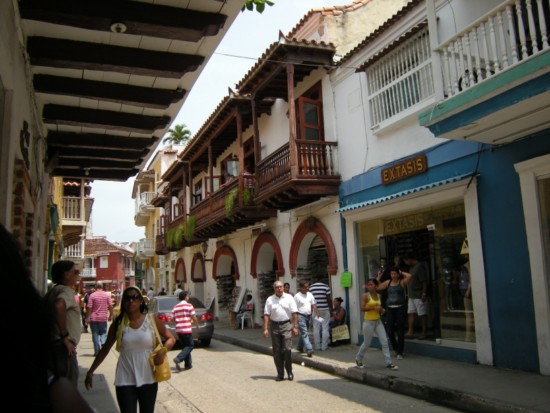
Over the years, we have come to realize, depending on the nature of a city, some places are better enjoyed without the structure of an itinerary. Cartagena, behind the walls, is just that kind of place, a walking city beckoning you to wander its narrow cobblestone streets and allowing serendipity, and not a tour book, to be your guide. Historic Cartagena is a visual treat, a place where color takes advantage of every available surface, the character of the paint expressing the style of the owner or the passage of time. The grand buildings, expressing colonial and republican charm, are painted in soft shades of pink, peach, white and ochre and the smaller ones, usually one story, formerly occupied by workers and tradesman, are painted in a varied palette of bold colors.
Cartagena is a mélange of many cultural influences, a mix of people, Caribe Indians, Black Africans, Arabic, Spanish and other Europeans, who have been blending in an ethnic stew for over 500 years. Life here is lived out on the streets in a perpetual carnival pulsating with a vibrant Caribbean atmosphere. This city, with its seductive charm, is waiting for you to soak it up and to seep gently down into it. It is an emotional place that should be engaged, not so much studied; a place to be felt more than read about.
Historic Cartagena is divided into four sectors. Our hotel, located on Calle Santo Domingo, was in the Center or Calamari district and on our second morning in Cartagena, we set out on foot to explore this area first.
ON FOOT IN CARTAGENA
It was still early but the humidity here works 24/7and even before we could step into the street, it had us cloaked in a soggy wet blanket. Our immediate concern was to find a banco, a place to change money. We turned right out of the hotel and then took the first left, arriving at the Plaza Bolivar, a popular gathering spot with a storied history. The moneychanger was located on the west side of the plaza and we found him in a small office behind a thick wall of glass. Donald presented him two crisp one hundred dollar bills and in turn received several sheets of bureaucratic paper work to fill out. The man, without reason to hurry, slowly examined the money, held it up to the light, marked it with a pen and finally decided it was good enough to exchange for Colombian pesos. Apparently not trusting his calculator or his computer and relaying on nothing more than an invoice book and a sheet of carbon paper, he began to do the math by hand. Losing patience, I stepped outside and found myself standing in the former Arcade of the Scribes. In the past, illiterate people came here and paid a “scribe” a few pesos to write a letter or fill out a form. Gabriel Garcia Marquez, Colombia’s most famous author, worked in Cartagena when he was a young journalist and used the city as the background for several of his books. Those who have read Love in the Time of Cholera will recognize this to be the place where Florentino Ariza, one of the main characters in the book, worked as a scribe.
With our dollars changed into pesos, Donald and I walked across the street and entered the Plaza Bolivar, already filled up with morning visitors. During colonial times, this was the center of political and religious life. The Cathedral, home to the archbishop, is located on the eastern side of the plaza and rebuilt after Sir Francis Drake’s attack in 1586. The headquarters of the Inquisition is located on the north west corner and during colonial times, this square was called Plaza Inquisition. Established by the Dominicans to guard the purity of the Catholic Church against heresy and witchcraft, the Inquisition was exported to Cartagena in 1610. However, it was not carried out in the Spanish colonies with the enthusiasm experienced in Europe. Today, their early 17th Baroque building has been restored to its former glory and turned into a museum explaining the Inquisition with exhibitions of the torture instruments used to gain confessions. The Gold Museum and the Central Bank are both housed in renovated colonial buildings, adding additional grandeur to the park area.
With the advent of independence from Spain, the hated Inquisition was closed down and the plaza was turned into a bull fighting ring. Then in 1896, it was renamed, this time to honor Simon Bolivar. In 1810, Cartagena tried to liberate itself and became one of the first towns to declare independence from Spain. However, by 1815 this attempt had failed and even though they were defeated by the Spanish army, Bolivar called Cartagena “la heroic”, the heroic city. Cartagena would eventually gain independence in 1821 following Bolivar’s defeat of the Spanish at the Battle of Boyacá near Bogota in 1819.
Today an equestrian statue of Bolivar is in the middle of the plaza and benches line the perimeter. It has been landscaped into great expanses of green punctuated with large leafy trees, palms and rubber trees, providing shade from the over bearing sun. Donald and I sat on a bench, joining the others in people watching. Everyone seemed to be waiting for someone or something else, but for us the nothing that happened was done in a most interesting way. Food vendors pushed their carts through the park, offering a wide variety of freshly squeezed fruit juices, fried arepas, and ice cream. A young man’s small cart consisted of nothing more than one coffee thermos and a few cups. We were offered lollipops on long sticks, peanuts wrapped in newspaper and cigarettes sold one at a time. While children chased the pigeons and old men played dominoes and chess, Donald and I tried to discourage the shoeshine boy, no we did not want our sneakers polished black and we did not need any shoelaces. Armed policemen were keeping a close watch on the park. For us, the measure of security they provided was always mitigated by the thought of why they were still needed.
With Garcia Marquez’s Florentino Ariza as our guide, we walked in his footsteps to the Plaza Fernandez de Madrid, finding ourselves in the San Diego district, formerly an upper class neighborhood, home to wealthy businessmen and high ranking military officers. In the novel, Florentino’s love for Fermina would go unrequited and just like him, we sat on a bench under what I hoped was an almond tree and stared at the white house across the street which Garcia Marquez used as the model for Fermina’s home. Just as he described it, there was a large balcony and a doorknocker in the shape of a parrot. Called Gabo by his friends, Gabriel Garcia Marquez, now in his later years, returned to Cartagena and built a house. We were walking in that direction until the sounds of music filling the air caused a small detour and we found ourselves in the nearby Plaza de San Diego, adjacent to the School of Fine Arts. A jazz band was practicing a Latin version of “Falling Leaves”. While listening to Roger William’s piano version reinterpreted into a salsa beat, we viewed an unexpected student art show.
We finally made our way down Calle del Curato and at the corner, near the walls of the city, we stood in front his Gabriel Marquez’s house. It is an artful arrangement of cubes and arches designed by Rogelio Salmona, Colombia’s foremost architect who clad Bogota in red brick. Keeping him in or keeping us out, the house is hidden behind a high forbidding wall painted the color of rust.
Donald and I walked through the San Diego section, back to El Centro and to the plaza adjacent to the city’s main gate. Along the way, we marveled at the beautiful balconies where brilliantly colored flowers cascaded over the railings. Using our eyes to peel away the encrusted layers of time, we knew the wooden balconies were constructed in colonial times and the stucco ones constructed after independence during the time of the Republic. A cacophony of sounds filled the streets, a group of young men sitting on over turned crates strumming guitars, vendors crying out, advertising their fruits and vegetables sold from wooden carts. We passed the palenqueras, Caribbean women dressed in their traditional colorful skirts and blouses selling fruit from baskets balanced on their heads. They seemed to sway down the street to the sounds of Caribbean music pulsating through the thick air, once again from unseen sources. Cartagena’s private life goes on behind high walls and heavy ornamental doors. Nevertheless, I interpret a door left open as an invitation to step inside and we were often rewarded with scenes of courtyards filled with fountains, flowers and shade trees.
Thick walls surround historic Cartagena and the main entrance, facing the bay, is through a triple arched gateway guarded by a drawbridge that is no longer there and a clock tower that forms part of the iconic scene. During the latter part of the 19th, it became fashionable to place clocks in public buildings and one was placed in this tower in 1888 giving the gate the name, Puerta del Reloj, Clock Gate. In the area in front of the gate, Plaza de los Coches, there is a statue of Pedro de Heredia, the founder of Cartagena. This plaza is the site of the former slave market, the largest such market in the Americas, and by the time slavery was abolished in 1811, over one million people had been processed through here. A series of buildings face onto the plaza and underneath its arcaded façade is the El Portal de los Dulces, stall after stall selling candy presented in glass jars. When we arrived, the plaza was alive with activity, people walking through, construction workers restoring an old building, and bus tours gathered around Pedro de Heredia. At the edge of the plaza, a man was standing on a wooden crate waving a Bible in the air, apparently preaching to a small crowd that had gathered to listen. Several days later, we returned to this plaza in the late afternoon. By that time the famous restaurant and bar, Fidel’s, had set up their chairs and tables and even though we never felt a cooling sea breeze and the sunset was hidden behind the clouds, we enjoyed a cold beer while listening to music and watching the local dance troupes that perform each afternoon in the plaza.
We walked to the adjacent square, Plaza San Pedro. It is named for Peter Claver the 17th Spanish monk who was appalled by the inhuman treatment of the slaves and while attending to their needs, managed to baptize over 150,000 of them. For this work, he became the first Spanish churchman in the Americas to be canonized. The nearby church is named for him and its ochre colored cupola can be seen from most parts of the city. The day we were there, we had the entire plaza to ourselves and spent time looking at the metal sculptures depicting people at work on traditional crafts and trades. Their Modern Art Museum is nearby and stepping inside, we gratefully welcomed the air conditioning. While cooling down, we wandered through their collection of Colombia as well as Mexican artists. The art was abstract and expressive and the air was chilling. The building is an excellent example of how their historic buildings are being renovated to accommodate modern needs while still maintaining their original façades.
As anyone knows who has spent time in tropical heat, the siesta exists, not because the people are lazy, but because it is necessary to get out of the sun. After enjoying the museum, finding a place for lunch and walking back to the hotel for a rest seemed a good idea. As the days past, we would tour in the morning, siesta in the hotel and then come out again in the early evening. Was it inevitable that the cloud cover would persist or were we fated to enjoy a sunset over the Caribbean Sea? We never knew, after all, we were in Cartagena.
Photogenic Paraty, the 17th Century Portuguese Colonial Town in Brazil
by TomBel on Oct.19, 2010, under Brazil, photography, Portuguese colonial architecture, UNESCO sites & monuments, unique towns
On the Costa Verde, Green Coast of Rio de Janeiro state of Brazil, about four hours south of Rio itself, is found Paraty. Costa Verde coast was one of the first areas of the long Atlantic seashore of Brazil visited and inhabited by the Portuguese. Set in a scenic bay and guarded by a fortress against attacks by pirates, Paraty port provided excellent shelter for the Portuguese ships. With the discovery of gold in Minas Gerais in the late 16th century, Party became the principal port of the Royal Road, the Estrada Real, that started in Diamantina and traversed through the key mining towns of Ouro Preto, Mariana, Congonhas, Tiradentes and Sao Joao del Rey.
Declared as one of Brazil’s first UNESCO heritage sites, Old Town Paraty is laid out in a perfect grid of streets studded with priceless classical colonial buildings and churches. As if part of the grid the port of Paraty was whence Portuguese ships sailed from carrying gold and diamonds back to motherland. In high tide the streets closest to the seashore flood, washing off the ancient cobblestones. Closed to vehicular traffic, Paraty retains ambiance of bygone era, with horse pulled carriages rumbling through. Tour of Paraty remains one of the highlights of a tour to Brazil.
Holasovice – UNESCO Site of South Bohemian Folk Baroque Architecture
by ph on May.31, 2009, under art & architecture, Czech Republic, Europe, Folk Baroque, UNESCO sites & monuments, unique towns, Vernacular Architecture


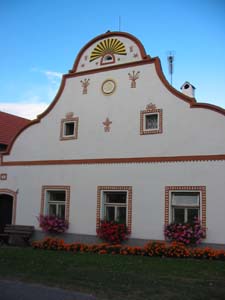
Some ten miles west of Ceske Budejovice in southern Bohemia, Czech Republic, lies a small village of Holasovice. The village is a well-preserved collection of village dwellings built in the middle of 19th century and offers a perfect day trip from Prague.


With characteristic stucco decorations on the gables built in style of folk baroque, inscribed with dates from 1840 to 1880, some with a touch of rococo and classicist features, the dwellings are grouped around a village pond, preserving a ground plan dating from the Middle Ages. This vernacular style of peasant architecture is known as the South Bohemian Folk Baroque. For its unique character and compliance with preservation regulations Holasovice village was added to the list of UNESCO World Cultural and Natural Heritage sites in 1998.

In all there are 22 buildings that surround the fish pond and the village square, with a small chapel on one end. The main entry doorway of each house leads into a large interior courtyard. The houses are large, typically with a number of rooms in the front part of the house and farm animal and implement barns adjacent.
Although similar architecture is found throughout South Bohemia, where many farm houses have been turned into vacation homes, at times disrupting the original vernacular style by addition of contemporary design features, Holasovice as village and the property owners abide by strict rules and maintenance guidelines to retain the cultural continuity of the vernacular elements of the village folk baroque period.
Holasovice is also a wonderful stop to inlcude in your Czech Republic bicycle trip, namely Vienna to Prague and Salzburg to Prague, or it can be combined with a trip to Cesky Krumlov, another Czech Republic UNESCO World Heritage site, on the tour of best Bohemian and Moravian greenways.