hiking & trekking
Cost of hiring a Sherpa for your trek in the Nepal Himalayas
by tb on Sep.20, 2009, under hiking & trekking, Himalayas, Nepal
The main trekking season in the Nepal Himalayas is beginning now. October to early December is the main season for trekking in the Sherpa Solu – Khumbu region, the Annapurnas, Langtang Himal, Himalchuli and Manaslu as well as Kanchenjunga.
While springtime, May to early June, is an ideal time for ascending Mt. Everest and some of Nepal’s other prominent peaks, fall generally offers clearer skies for trekkers. In the spring monsoon is fast approaching and skies are always hazy though it is warm even in high altitudes thus a best period for summiting Everest. October and November is the ideal season for trekking.
Great number of trekkers in Nepal book tours from established Nepal tour and Himalaya trekking operators in the United States or Europe well before departing for their trip. Many trekkers, however, come to Nepal entirely on their own hoping to arrange trek support in Kathmandu. So what are the costs associated with hiring a Sherpa in the Nepal Himalayas?
Minimum cost of a Sherpa is Rs. 650 (Nepalese rupees), that’s about $10 per day. It’s important to note that this rate applies for the service of a Sherpa staff, a camp hand, porter or a cook possessing essential experience having worked with trekkers in the past, though the rate does not include allowance for his lodging and meals namely if staying in local lodges. Those expenses will have to be covered by the trekkers in addition to the Sherpa basic rate.
Tour operators will have to also pay for the Sherpas’ health insurance (rates start as low as Rs. 3500 ($50) per person) and in some instances, for example on certain climbing expeditions, the operators must also provide all necessary personal gear for the Sherpa, from special boots to down jackets especially if they will be working in exceptionally high altitudes.
Experienced Sherpa mountain guide is referred to as “sirdar” and his will cost is well above the mentioned rate for Sherpa staff. Top expedition Sherpa sirdar can earn over hundred dollars per day, even more, especially on large expeditions when he manages a sizable team of other Sherpas. The head Sherpa guide or sirdar assigns and coordinates responsibilities of the entire expedition support team, hires and pays the porters, pack animals and their caretakers and makes all the necessary decisions regarding routes and camping sites.
While Sherpas act as essential porters on high altitude treks such as ultimate Everest treks to Gokyo Ri, Kala Pattar, Chukung Ri and similar destinations, in lower elevations of, for example, the Annapurna circuit trek up to Manang along the Marsyangdi River valley or up the Kali Gandaki River valley to Muktinath, the Sherpa guide will hire local porters from other Nepalese tribes, namely Limbus, Rais, Thamangs or Gurungs. Their daily rates may vary.
Porter rates start at Rs. 1065 ($15) per day but proven high altitude Sherpa porter will earn considerably more. The said rate is based on carrying 40 Kg load, approximately 88 pounds. In 2008 the rate was Rs. 850 ($ 12) per day, so rates in 2009 have increased.
All Himalayas expeditions will also routinely employ the services of a yak, an absolutely essential pack animal for trekking in high altitudes. In 2008 yak daily rate was Rs. 900 ($13); in 2009 minimum daily tariff is Rs. 1200 ($17) per day. Of course yaks must be handled by a yak driver, their caretaker, and his minimum daily cost starts at Rs. 1200 ($15) per day.
Aside the Sherpa and pack animal expenses trekkers in the Nepal Himalayas will each have to get a trekking permit issued for the specific region where they will trek. Himalayas trekking permit for Solu – Khumbu currently costs Rs. 2750 ($ 40).
Additionally, as most trekking areas in the Nepal Himalayas are now within boundaries of national parks trekkers must also pay national park fees, typically Rs. 2000 ($30).
Over and above the noted costs trekkers will have to pay a daily tariff that includes full expedition support, costs that will include quality sleeping tents and mats, dining tent, toilet tent, and all the necessary camp gear, kitchen gear, food provisions and cooking fuel, buy their own health and evacuation insurance as we as pay for any other extras not mentioned above. All in all the quality of all Himalayas expeditions will not be the same and much of any trekking tour’s true success depends on the experience and leadership abilities of its sirdar, the Head Sherpa guide. In this regard, before you commit to booking a trek lead by a Sherpa team, a reliable Nepal Himalayas client testimonial will be essential to know your group will be guided by a true professional Sherpa guide.
Best of Argentina – Torres del Paine or Cerro Torre and Mount Fitz Roy?
by tb on Aug.08, 2009, under Adventure, Argentina, hiking & trekking, Journeys of a Lifetime, National Parks, unique mountains, wildlife watching

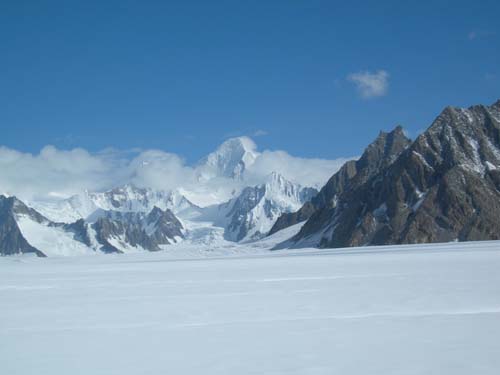
Fitz Roy
How best to visit Argentina obviously depends on how much time you have available to travel. Most visitors will arrive in Buenos Aires and begin their trip from there. It seems although many profess wanting to tour Argentina one of the first places they wish to visit is Torres del Paine National Park. There is no question that Torres del Paine is a spectacular park, but the fact is it is in Chile and not Argentina.
Though to fly from Buenos Aires to El Calafate, in the heart of Argentine Patagonia, and overland from there, is geographically straight and shortest way to get to Torres del Paine, the transportation to the park is not exactly overabundant. There is public bus from El Calafate to Puerto Natales and Punta Arenas one can catch and hop off it at the park’s entry, and private transfers are available as well though not plentiful nor cheap.

Hanging glaciers in Torres del Paine
Without a doubt the best access to Torres del Paine is from Punta Arenas, the focal point of Chilean Patagonia. Of course this poses a bit of a dilemma if starting from Buenos Aires. To get to Punta Arenas can be done either by flight via Santiago de Chile or by going to Bariloche in the heart of Argentine Andes first and from there overland across the Andes Lakes District to Puerto Montt and fly to Punta Arenas from there.
If going to Punta Arenas via Santiago may seem like a cumbersome detour, then add a stop and break up the trip by visiting Mendoza first. Mendoza is an easy flight from Buenos Aires and on the way to Santiago. In Mendoza you can tour the best wineries of the region, sample local dishes, lodge at some wonderful hotels, and after three or four days continue on to Santiago.
Another alternative is to forget Torres del Paine altogether, tailor it into your itinerary on a future trip focusing on Chile only, and instead proceed from El Calafate to El Chalten, a base town for treks into the wilds of the incredible Cerro Torre and Mount Fitz Roy. If you may be on a limited time, from El Chalten you can head back to El Calafate and return to Buenos Aires from there. With two weeks to spare you can visit both Fitz Roy and Torres del Paine and you can even add Southern Patagonia, Argentina’s legendary Tierra del Fuego.
Following are the very best three options for experiencing Best of Argentina on 15-days, starting from Buenos Aires.
Option one is to fly from Buenos Aires to El Calafate, overland to El Chaltén, then to Ushuaia and finish with Iguazu Falls. This Best of Argentina itinerary allows for tango in Buenos Aires, seeing the spectacular glaciers, hiking in Fitz Roy National Park, sailing the Beagle Channel, and in the end marvel at the impressive Iguazu Falls.
Another Best of Argentina itinerary on 15 days is a variation of the above with the inclusion of a visit to Mendoza, so in summary the itinerary packs in Tango, Wineries, Glaciers, Tierra del Fuego, Beagle Channel, and Iguazu Falls.
Some would argue I left out Salta and the northwest of Argentina but for logistical reasons best to leave that part for another trip.

Trekking in Torres del Paine
Trekking in Ladakh – Part 7
by Alexandra Rosen on Jul.17, 2009, under Alexandra Rosen, hiking & trekking, Ladakh, Trekking, Trekking in Ladakh
AT THE CAMP SITE
At 4:30 I walked over to the house, actually a two story concrete box. An opening had been left for a window, but the glass had not yet shown up and the floor was hard packed dirt. Numgal was sitting on a jute sack surrounded by his kitchen and Dorje was checking on his donkeys. All of us would work on dinner and when Dorje returned from his donkeys, he gave me an odd look when I suggested he wash his hands before helping. Dorje cut the lamb into cubes, which I liberally sprinkled with Numgal’s panoply of spices. He had found a bent piece of wire and after hammering it relatively straight, had cut it into skewers. A small fire was burning in the attempt to turn willow branches into charcoal. All was going well and we agreed dinner would be at 6:30. While the meat was marinating, I returned to my tent to check up on Andrew Harvey’s spiritual progress, as compared to mine.
Tonight’s dinner had all the makings of a feast. Because we had so much meat left over and all of it had to be eaten that night, we invited the owner of the camp site, who brought along a friend. That afternoon two goat herders, along with their goats, had shown up, and they were invited. When I returned, Dorje had already made his chapattis and had the skewers roasting over the coals. Numgal had cranked up his pressure cooker and the dal and rice had already been prepared, along with a saute of our various vegetables. We had more lamb than skewers and Numgal had fired up the remaining meat in onions and garlic. The menu now included lamb two ways.
When I arrived at 6:30, a fire had been lit and all the men were sitting around waiting for dinner. They had prepared a special place for me and I sat on a camp stool with the vegetable crate as my table. Once again, everything Numgal prepared was delicious. Each person ate in his own way, ranging from knife and fork, to spoon, to just fingers. I do not think willow wood will replace hickory or mesquite because it left a rather unpleasant taste on the meat. But no one seemed to mind and they ate until the lamb was finished. If an anthropologist had been there, she would have been very pleased to hear the old goat herders singing around the camp fire, with the younger men chiming in. This was the night of the full moon, the Buddhist symbol for enlightened consciousness. (Buddha was born and entered Nirvana during a full moon). We never saw the moon that night because it remained completely hidden behind clouds, not a good sign.
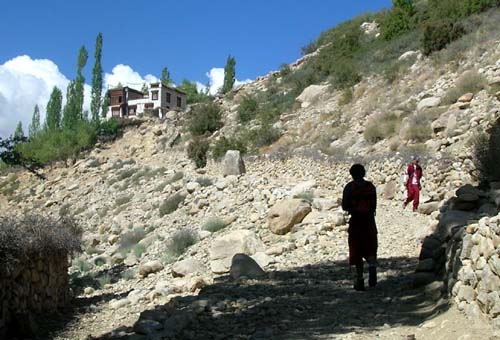
Leaving the men around the camp fire, I returned to my tent. I had no trouble falling asleep with the sound of the rushing stream in one ear and the sounds of donkeys braying in the other. Morning came too soon. Dorje showed up with the promised bowl of hot water and the pot of tea. It is surprising how clean one can get with just a small amount of water. Later he returned with a breakfast tray loaded down with fried eggs, toast, cereal, and puris. Numgal and I left the campsite around 9:00, heading for a monastery 2 ½ hours away and on the way back we would walk through the nearby village. Not veering too far away from the stream, the path wrapped around the contours of the mountains. Once again the walking was easy until we encountered rock slides. We passed traditionally constructed houses with their ancient apricot orchards and the familiar chortens and mani walls. We lunched and rested in a willow grove. The walk up from the river bottom to the village was as demanding as the one I experienced the day before, expect this time the sun was hidden by dark grey clouds. When we returned to the camp, we had been walking 5 ½ hours.
I was doing fine and quite capable of going forward after a little rest but the main concern was the cloudy sky. June was supposed to be the dry season but by late in the afternoon it began to rain. That night we ate inside the building. The meat was finished and we enjoyed a vegetarian meal, along with a soup he reconstructed out of a soup mix. I sat on the camp stool behind the vegetable crate table and Numgal and Dorje sat on jute sacks. This time I brought the damask placemat I had “borrowed” from Jet Airways. Candles were lit and it was quite cozy.
The sound of the rain beating on the tent lulled me to sleep but the night was not for sound sleeping. I woke up at 4:00AM, either because I was burning up in my sleeping bag as its tight contours would not allow me to turn over or because it was necessary to stop the absurd dream playing on my mental DVD player. I had been dreaming that the rain had caused a flash flood and I was locked inside my tent, hurdling down the turbulent waters. I woke up just before I was deposited into the Indus River. Had I known at the time this tent had holes, I would have saved myself all this trauma. At 5:00 AM I awoke to the call of two magpies discussing a few things in the willow trees close to my tent. I had seen them often and they are the size of pigeons with a white chest and white tipped blue black wings. By 7:30 when Dorje appeared with the hot water and the pot of tea, the rain was reduced to a drizzle. They packed up the camp site and dressed in rain gear, we set off. We had one more pass to cross and this one measured in at 11,500 feet.
WALKING IN THE RAIN
The incline toward the pass was gentle and soon the rocky path turned into soft grass, enjoyed by everyone, including the donkeys. Mountain roses lined a dry river bed and even in the misty morning their deep pink color was impressive. But like most things beautiful, there was danger as their blossoms were protected by giant thorns. We reached the summit in forty minutes and once again I placed a stone on the mani wall. The weather was not progressing well. The higher we climbed, the heavier the rain and the stronger the wind. I was wearing a rain jacket and rain pants and protected from the rain outside. But inside I had made the mistake of layering my clothes over my thermal underwear. The further I walked, the hotter I became and soon there was a raging sauna inside my rain outfit. It was raining too hard to take off any clothing. Below us stretched another oasis, its organic form expanding out to the base of the surrounding mountains. The descent was easy and in an hour we had arrived at our next camp site. At this lower level, the rain had turned into drizzle and the mist had closed in on the valley, reducing our view almost to the hand in front of our faces. The camp site was already filled with tents. There was a main house and a guest house, similar to the one I had slept in several nights before. Numgal commandeered a block house and set up his kitchen and cooked up lunch while Dorje set up my tent as far away from the other tents as we could get. The rain returned, the temperature dropped, and retreating to my tent after lunch, I found I had taken on water. Nothing was damaged because, thanks to my friend’s advice, everything I had was in zip lock bags. Numgal came with a bowl and spoon and collected as much water as possible. I spent the remainder of the afternoon in a very damp tent, wondering if I was still having fun.
It is time to shorten up the story. Late that afternoon, I abandoned the tent, collected my belongings and checked into the guest house. It was not much but at least there was a dry roof over my head. Numgal and I agreed that if the rain did not stop we would make other arrangements. The following morning it was still raining. Time to make the phone call. Numgal was able to call from the large house. He contacted the tour company and an hour later we were driving down the road, heading to a new destination. I was actually sorry to leave Dorje behind as he had become such an important part of my experience. I tipped him most generously and he collected his donkeys and began his own trek home. He would be there in four days.
The driver who picked us up remained with us for the duration of my stay in Ladakh. He was an old man, set in his ways, and not always receptive to my constant requests to slow down. Numgal and I continued to tour the country. We visited more monasteries, attended religious ceremonies, and crossed the 19,000 foot pass into the Nubra Valley, which may be listed as one of the places at the end of the earth, even after I had arrived. Back to Leh, I spent one more night at the Deskit Guest House before returning to Delhi, where I would spend a few more days before going home. At the Delhi Airport I found Suzy, Doris, and Doris. In our own way, all of us enjoyed our experiences in Ladakh. Like you always do, we promised to keep in touch.
TREKKING
Even though it may seem dated, people are still coming to Buddhist countries to “find themselves” and like the author I was reading during my stay in Ladakh, they come hoping to peel away enough of the accretions of Western life to allow their inner selves to spring free. Hoping to comprehend the oneness of the world, they willingly trade in Western material values for Buddhism’s spirituality and emphasis on wisdom and compassion. The process implies an uncovering of what you really are. I did not go there to find myself, and even though I enjoyed visiting the monasteries, I was not seeking spirituality. I did not intend to strip down, but to “suit up.” I arrived eager to collect experiences which would enrich my concept of myself. I also went to Ladakh to test myself and each mountain I climbed was my own personal Everest. I enjoyed the sense of achievement and I had fun. When the rain came, the fun went out; there was really no reason to continue. The tour company organized another program and Numgal and I continued touring. We kept all of our supplies and each night in the guest house, Numgal set up his kitchen and even though the accommodations were rough, I continued to eat fantastic Indian food.
I was very fortunate to have Numgal for my guide. He was a fantastic twenty something and as a practicing Buddhist, a true example of wisdom and compassion. I left satisfied and I am sure Numgal was very pleased with me. The experience was so rewarding that I have contacted Tomas at Footloose Travel Guides to set up another trek. This June (2008) I hope to be e-mailing from the path to Mustang. Look up Nepal on a map, locate the Kaligandaki River that runs through the middle of the country and up in the northern part of the country you should find Mustang.

Trekking in Ladakh – Part 6
by Alexandra Rosen on Jul.17, 2009, under Alexandra Rosen, hiking & trekking, Ladakh, Trekking in Ladakh
I was dressed and ready to go when Numgal knocked on my door at 7:00, bringing me a bowl of hot water and a pot of tea. Room service cannot get much better than this. When I entered the cook tent, Dorje ushered me to my same table. Numgal had prepared fried eggs, complete with toast and jam and had turned last night’s rice into morning porridge, flavored with the left over apricots. Dorje had steamed the puris, quite a feat considering we did not have a steamer.
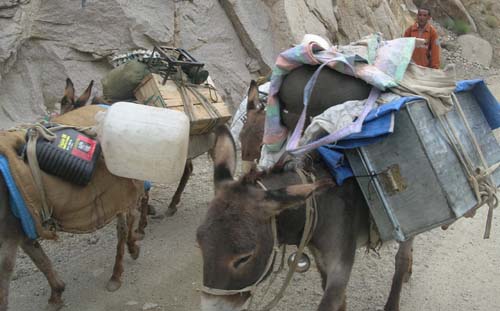
While I enjoyed breakfast, Dorje loaded the donkeys. In Ladakh, sturdy cardboard boxes are scarce and it is easier to rely on old fashion methods of carrying goods. We had several tin trunks and many jute sacks. Because there is no packing tape, these sacks were secured by sewing them closed and of course, each time they were opened, Dorje would sew them back together. Our vegetables were stored in a slated wood crate and the eggs were placed in double sided egg cartons.
By 9:00, our small caravan was ready to leave, four donkeys, Numgal, Dorje, and me. The largest donkey had to carry my luggage and I sensed he was looking at me wondering why, even out here, I had to bring so much stuff. The baby donkey only had to contend with Numgal’s kerosene burner, bottles of extra kerosene, and the egg carton. When we reached the paved road, Dorje turned right and I started to follow him until Numgal pointed to a small path leading in another direction. Our trek was through the countryside and the road would be used only when necessary. I waved goodbye to Dorje and the donkeys and soon Numgal and I were walking along the edge of terraced fields planted with barley, wheat, and the brilliant yellow flowers of the mustard seed plant. Like every other Ladkhi morning, the sky was royal blue with a few fluffy clouds hanging over the snow capped peaks framing the distance. Once again, the clear air intensified every color in the landscape. We passed by a house and looking up, I saw a little boy wearing a monk’s robe, looking out the window. He called out “juley, juley” and I felt he was wishing me good luck. We were joining a morning in full swing and the people hoeing in the fields stopped and waved. At this time, the sun was still in a gentle mood, without giving any hint of what was to come. Finally, my trek had begun, and if joy had a sound, beautiful music would have resonated across the valley.
After about a thirty minute walk through this luscious oasis, my idyllic moment confronted reality. By definition, oases end in deserts. I had seen this same scenery from my balcony and many times from the van. But now I was standing at the edge of an endless stretch of desert, an ocean of sand extending as far as I could see and bordered on each side by barren mountain ranges. Numgal pointed into the distance and said we were heading toward a mountain pass, not yet viewable. At this point, my shoes were working out fine, as I had spent time breaking them in, the legs were going good, but my back was really hurting. I had given my original backpack to my temple guide and bought a new one which had a mesh backing, but unfortunately within thirty minutes I found out I was not capable of carrying it on my back. Numgal noticed my situation. Without asking, he took the pack and slung it across his chest. I sincerely apologized, but he said the weight was nothing to him and not to worry. While Numgal toted two packs, I was left with my water bottle, actually a refilled plastic coke bottle, and my camera. With my hat on and my cotton Khmer/Cambodian scarf wrapped around my neck, we entered the desert.
WALKING THROUGH NO MAN’S LAND
Once we got started, walking was surprisingly easy because the sand was so firmly packed, but how little I knew at the time that this terrain would not last. The land was totally barren, a desiccated place with not a thing attempting to grow. Wrapped in solitude, we were the only ones there. We were gaining altitude but the incline was so slight that it was hardly noticed. I thought we were making good time and thirty minutes later we had cleared the pass which was listed around 11,000 feet. The tour program described it as a “small pass” but for me it felt like success. We took a short rest. Numgal took my victory picture as I stood under the Buddhist prayer banner, and I placed a stone on the mani wall. These walls carry religious meanings and many times the stones are painted with Tibetan Buddhist symbols. People add stones in respect to the Buddha. Also, placing a stone on the wall is a way to confirm your existence in the presence of an unforgiving, indifferent landscape, where there is no other sign of life but yourself. From the crest of this mountain, Numgal pointed out our next pass. At best I could tell, he was pointing to mountains far in the distance.
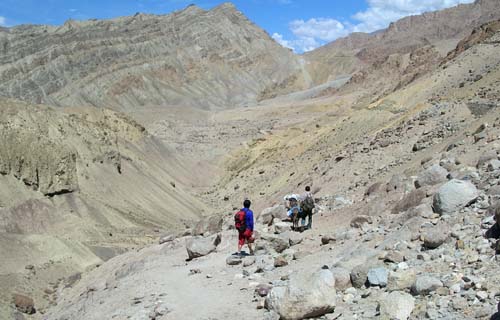
I soon learned whenever we climbed up we would eventually be heading down. As we began our descent, we quickly found the previous hard packed sand had turned into loose gravel, which in turn evolved into large stones. Walking now became difficult and to add another degree of difficulty, the sun was warming up. Slowly we made our way down the mountain and at the bottom found ourselves in a ravine with a dried out river bed. With tall mountains hovering over us, we followed the path, which attempted to hug the contour of the mountains. We confronted rock slides, as if the mountains had discarded everything they no longer needed in order to annoy anyone who dared walk past. The path across the rock slide was so narrow that it could accommodate only one foot at a time. I was now walking through those barren mountains I had seen from the balcony, glowing golden in the early morning sun. Seen close up, experiencing their jagged stones underfoot, they certainly produced another point of view. Eventually, the path turned upward and when we finally reached the top, we rejoined the paved road and saw Dorje and the donkeys coming around the bend.
The donkeys did not like walking on the hot pavement and preferred to walk along the graveled edges where they could stop and nibble tasty wild flowers. Dorje now carried a stick to encourage them to keep moving. As for me, I had no trouble walking on the road; here at last I found solid footing while I enjoyed having this little part of the world all to ourselves. But this respite was short lived and heading toward that second pass in the distance, Numgal and I left the sealed road and began walking down what Numgal described as an ancient sheppard trail. We repeated the same process as before and the closer to the bottom, the looser the gravel, and the larger the stones. But this time at the bottom, we found a stream flowing swiftly with cold melted snow. Numgal pointed to a grove of willow trees alongside the bank and said we would stop there for lunch.
The green banks of the river looked like Paradise, but as any Buddhist knows, sometimes it is not so easy to attain. As we approached, we realized the willow grove was guarded by a wall of bramble bushes and very carefully Numgal and I crawled through. I collapsed on a soft grassy patch. It was 12:00. We had been hiking up and down mountains for three hours and Numgal said we had two more to go. Along with my pack and his pack, he was also carrying our lunch. This time the hardboiled egg was fantastic and I even enjoyed what had now become the ubiquitous boiled potato. He had made peanut butter sandwiches out of the left over puris and he also included two boxed juices. For a surprise, he added a few pieces of cheese. I shared a power bar with Numgal and hoped this supplement to lunch would deliver what had been promised on the wrapper.
The sun was high above, making its presence well known to those of us down below. Even the temporary shade of the willow grove could not keep us cool. I laid down on my back in the soft grass and placed my Khmer scarf, dripping icy water, over myself like a shroud. Only the wild mountain roses seemed to enjoy the heat and their deep pink blossoms radiated in the bright sunshine.
It was 1:00 when we began to climb out of the river bed, heading for the top. My Khmer scarf had almost dried off and I soaked it again in the freezing water, wrapped it around my head to try to stay cool, and said, “let’s go”. I didn’t care if I was confronting a high hill or a mountain, all I knew was the path went straight up and was covered in loose gravel, the kind where you take one step forward hoping you do not take two steps back. The sun had become a scorcher, as if it only had eyes for us and the oppressive heat and the steep incline made the walk up extremely difficult. Wrapped up in my scarf with only slits for eyes, my view of the world narrowed and all I was able to see was the ground below me, which I was conquering one painful step at the time. Even though the water dripping off my scarf had a cooling effect, the moisture attracted large flies that swarmed around me, making their nasty buzzing sound. Swatting huge flies was just another degree of difficulty as I trudged upward. Numgal kept turning around to make sure I was still going and when he got too far ahead he stopped and waited for me to catch up. There were no trees and we rested in the meager shade provided by a large boulder but the sun remained relentless and the flies every vigilante. I was eying my watch, trying to walk at least fifteen minutes before I had to stop but at times I had to stop sooner. I kept wondering when that power bar would kick in. Finally, about an hour later, I was able to see the top and eventually we were there.
Walking a short distance, we found ourselves at the pass and once again encountered prayer flags, chortens (stupas) and another mani wall. I placed a stone on the wall and thanked Buddha just in case he had anything to do with my reaching the top. Numgal and I ate another power bar, even though I was very dubious about their effect and he announced we had only one more hour to go. In the distance I could see another oasis, the location of our camp site. The going was much easier and soon we rejoined the sealed road. By the time we reached our destination I figured we had walked five hours.
OUR CAMP SITE
The camp site consisted of a two story house built into the side of the road where the guides would sleep and a finger of land surrounded on two sides by a roaring stream, where tents would be set up for the trekkers. This area was reached by crossing a small bridge constructed from perforated steel plate, probably left over from an Army construction site. By the time we arrived, Dorje had already unloaded the supplies, fed and tethered his donkeys, and set up my tent. He placed it next to the stream under a willow tree and from somewhere found a chair and a foot stool, which he placed in front of the tent. This was the first time I saw the tent. It was a tent for two, providing plenty of room for my stuff. I had brought an inflatable mattress but the one they provided was much thicker, almost a proper mattress. With carabineers, I attached my three flashlights to the top of the tent, allowing the light to shine down like a small chandelier. The rest of the day was “at leisure”, spent reading a book. There were no other trekkers in the camp site and once again, I found myself alone in this great expanse of nature. Even though the going was rough at times, I had survived the first day and was looking forward to the next.
I looked up to see Numgal walking toward me carrying the tea tray. He thought we should do tea earlier and poured a cup of cardamom tea and offered me more cookies. Looking up at the vivid blue sky, I felt at one with the world and at the time enjoyed the tea as if it was a fine glass of champagne.
As I was reading under the trees, Numgal and Dorje set up the kitchen area. It was agreed I would return at 4:30 to help prepare the lamb for tonight’s BBQ. They did not quite understand the term, but I explained we would cut the meat into cubes, put them on skewers, and cook them over a wood fire. As for me, the reading lasted only a short time and I soon found myself napping with thoughts of sizzling lamb. To be continued.