Top Travel Leads

art & architecture

Thakali people of lower Mustang district: mixed traditions between Dhaulagiri and Annapurna

by tb on Feb.05, 2010, under Himalayas Architecture, Nepal

dhaulagirikali-gandaki-river-valleyMidway between the Bhotia, or Bhote, Tibetan ethnic groups starting with the Baragaunle Bhote villages north of Marpha and ending with the former kingdom of Lo, the Mustang Kingdom of upper Kali Gandaki south of the Tibetan border, and the Chetri, Magar and Gurung villages downstream south of Tatopani, the last pure Hindu village, there are villages of the Thakali people.

Located just about where the Kali Gandaki breaches the chain of the High Himalaya, with the Annapurna towering high above directly to the east and the Dhaulagiri to the west, located only at some 6000 feet above sea level, the Thakali villages constitute a clear transition it the cultural continuity along the watershed of this major Himalayan river valley.

Today the Thakali villages exude mixed traditions, a clear mixture of Hindu and Buddhist elements. When it comes to looking at the house type build by the Thakalis and the man-man physical characteristics of their villages as such one feels being already among the Buddhist populations groups further north. But close look at the dress of the Thakalis and the story told is of other aspirations.

thakali-womanTo the Thakalis themselves any connection to the Bhote and Buddhists is unwelcomed association that they have managed, in their mind, to shed beyond doubt.

Fact is most Thakalis today live in Kathmandu Valley and the origin of the Thakali ethnic group in terms of when exactly they had settled in the Kali Gandaki region is obscured by lack of historical documents. The only lead as to their probable and likely years of approximate settlement in the Kali Gandaki region may be the few old Buddhist gompas built along the Thak Khola, the Thakali term applied to the high valley of the Kali Gandaki, some of which date as far back as three hundred years.

thakali-manThe Thakalis have all the characteristic Mongoloid features, and their language is a special Tibetan dialect, hence relation to the Buddhists further north is undisputable. Regardless of their exact settlement in the Thak Khola, the Thakalis prospered since the mid-nineteenth century when they were awarded a monopoly over the salt trade with Tibet.

Tukuche, the largest Thakali village, in translation meaning something like the “Grain Market Place” (tuk-grain; che-flat place), has until late 1940s figured as the principal market town where salt from Tibet was bartered for grain from the Midlands and Terai. Unfortunately, due to the Chinese invasion of Tibet in 1959, the salt trade had completely ceased, constituting that today Tukuche is essentially only a relic to its once prominent past.

Although the Thakalis have since late 19th century conscientiously tried to establish a link between themselves and the Malla kings of Jumla in western Nepal, proclaiming themselves thus as Hindus, in order to raise their social status because Nepal as monarchy was essentially a Hindu kingdom, and today most with the exception of the very old have adopted Nepali style of dress, women wear sari and man topi (Nepali cap), one brief glimpse of the region of their settlement attests to nothing but an undoubtedly once great Buddhist past.

thakali-gompaNear and in practically every Thakali village can be found long mani walls and chortens as well as Buddhist monasteries.

inside-thakali-gompaThe Narshang gompa above Khanti, its skylight window adorned with fine frescoes of the traditional Buddhist imagery, including the image of Padma Sambhava, otherwise also called Guru Rimpoche or the Precious Master, the apostole of Buddhism in the Himalaya and Tibet, with the Kyupar gompa in the vicinity of Tukuche, have always belonged to the more renown of the Thakali Buddhist gompas. Two of the other more prominent Buddhist gompas of the region are the monastery of Ku-tsap-ter-nga, with a large covered corridor used for the ritual perambulation, surrounding its courtyard, and the gompa of Tsherok. And the Rani gompa in Tukuche is probably the oldest Buddhist gompa of the Thak Khola, believed to be built around the beginning of the seventeenth century. Though Bon-po influences at one time were equally as strong in the area, today most of the Bom-po gompas are in a tragic state of collapse, including the Bon-po gompa of Nabrikot.

entrance-thakali-houseIn all, the Buddhist heritage of the Thakalis has been sustained by only a handful of old monks and nuns that try to maintain the upkeep of the gompas as well as the Buddhist ritual. Were it not for the Panchgaunle people whose villages are found immediately north of the Thakali area of villages, who try to maintain the gompas and hold some of the traditional Buddhist festivals and ceremonies, the Buddhism in the Thak Khola would have died by now completely.

Although the Panchgaunle people consider themselves to be Thakalis, they are not Thakalis. The biggest village of their region is the village of Marpha, a compact village of narrow, cobbled lanes from which the courtyards of the houses are entered, in architectural style essentially identical to those of the Thakalis including the flat roofs, edges of which in Marpha are lined with neatly stacked supplies of firewood.

The Tibetan house types of stone with flat roofs have inspired the architecture of the Thakalis likely from the very beginning when they settled along the Thak Khola, however, the Thakalis have perfected this house type to a higher standard of design than have their Baragaunle neighbors to the north. The flat roof, suitable for drying of grains, upper level reached via the characteristic notched tree trunk ladders, is repeated in the design of each and every house in Thak Khola.

courtyard-thakali-houseAnother design feature, always present in the Thakali house, is the enclosed courtyard with usually a fodder barn and an animal shelter on the ground level. Undoubtedly the best designed Thakali houses are found in Tukuche, the former marketplace center of the extinguished salt trade and seat of once the richest traders.

The most effluent families constracted themselves large houses with spacious interior courtyards entered through tunnel-like gates located below often elaborately carved wooden balconies. The bottom floors of these houses included the necessary animal barns, grain storage rooms and servant quarters.

Kitchen, too, would be usually located on the ground floor, abounding in a variety of shiny brass pots displayed on shelves around the room. On the upper floor would typically be found the sleeping rooms, family chapel room, additional storage rooms as well as the main living quarters including another kitchen area, typically containing a ceremonial fire pit. The ceremonial, ornamental fireplace, is put up by the Thakalis only symbolically, and no fire is ever lit in it.

In the finest of Thakali houses of Tukuche the second floor rooms were entered off a fine wooden gallery, typically built around the entire interior perimeter of the house. Structurally, timber would always be used extensively, and a uniquely cut and colored T-post, serving the function of a ceiling supporting structural member, is found in every Thakali house.

fireplace-thakali-houseinterior-thakali-houserooftop-thakali-housethakali-house2Whether you are a trekker or have a deeper interest in the cultural diversity of Nepal, Thakali villages of Thak Khola offer a fascinating slice of the remote part of the Himalayas.

1 Comment :, , , , , , , , , , , more...

Graffiti Art below Barrandov Bridge in Prague

by tb on Nov.10, 2009, under Czech Republic, art & architecture

graffiti1Graffiti or “street art” is usually considered to be vandalism, act of defacing property. As any large city, Prague too has been confronted with graffiti art, though essentially unknown prior to Velvet Revolution of 1989. While “tagging,” writing of simple signatures, is especially looked down upon as senseless scribble, creative graffiti art is definitely present around Prague. In some areas of gray-prefab tenement neighborhoods, commonly constructed during forty years of communist era, creative graffiti projects have indeed been on occasion encouraged to mitigate the depressing architectural style. Other “legal-walls“ and surfaces maybe at times set aside by city governments and graffiti artists get invited to enhance the otherwise unsightly vertical space, including certain pedestrian underpasses and walkways, though the designated legal areas do not abound. That to allow creative juices free expression may produce fascinating graffiti art is no doubt. It not only provides for self-realization of the artist, but also is a wise move that curbs illegal graffiti. Following are graffiti under Barandow bridge, a well-know multi-lane freeway and pedestrian structure below the famous Barrandov Film Studios, and one of the legal graffiti walls, or zones, of Prague.

graffiti4

graffiti6

graffiti8

graffiti12

graffit3

Leave a Comment :, , , , , , more...

Dzong, the fortress style of architecture of Bhutan

by tb on Oct.09, 2009, under Bhutan, Bhutan architecture, man-made wonders

Inclined walls of the Punakha Dzongbhu24

bhu34Those with profound interest in architecture and decorative arts will find Bhutan a truly fascinating and inspirational place to visit. The architecture of Bhutan carries overtones of design features patterned on those of Tibet and the Himalayas in general, however, in Bhutan they developed clearly Bhutanese characteristics.

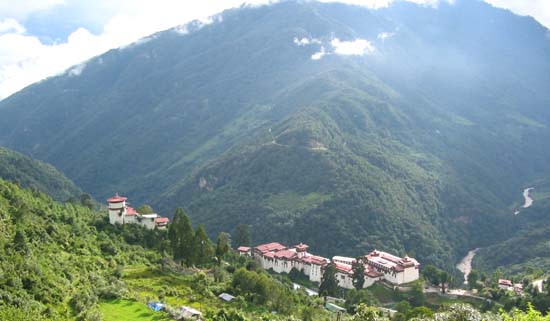
While Tibetan fortress style of architecture permeates the house, temple and monastic style of architecture from Ladakh in the Western reaches of the Himalayas to Kham region of Eastern Tibet, and is found north as well as south of the principal chain of the High Himalayas, in Bhutan the dzong, the fortress style of architecture, stands in a category of its own.

Massive in style, Bhutanese dzongs are essentially structures containing administrative offices of the government as well as temples and housing quarters for resident monks. Surrounding interior courtyards, the dzong exterior walls are typically slightly inclined in style of European medieval castles.

Dzongs of Paro, Thimphu, Punakha, Trongsa, Jakar, Trashigang, Mongar, or Simtoka Dzong near Thimphu all impress in their layout, lavishly decorated woodwork within, display striking carved posts and beams, nooks and niches harboring votive images, and above all by being sited in commanding positions, either at the confluence of rivers, on hilltops or spurs.

bhu56Trongsa Dzong

bhu32Wangdi Dzong

bhu29Temple within interior of a dzong

bhu28Intricate decorations on a dzong couryard building

bhu19Punakha Dzong

bhu17Thimphu Dzong

bhu25Exterior wall, window and main entrance balcony of the Punakha Dzong

Leave a Comment :, , , more...

Visit Bhubaneswar, Puri and Konark, the holiest temples in Orissa

by tb on Sep.28, 2009, under India, Orissa, art & architecture

Most tourists wanting to see India visit Rajasthan and then perhaps Goa and highlights of Kerala. Very few ever tour Orissa and visit Bhubaneswar and Puri. Yet these two cities on the eastern coast of India offer some of the most striking temples and can be used as staging points for tours into the interior of tribal Orissa.

Bhubaneswar, the capital city of ancient kingdom of Kalinga, is known as the Temple City of India. Among the finest and also the biggest of Bhubaneswar’s 600 temples is the Lingaraj Temple of Shiva built in the 11th century.

Best visited from Kolkata, start your tour of Bhubaneswar with the Mukteswara temple. Built in the 10th century, Mukteswara temple is known for its richly decorated stone arch at the entrance. With the tales from the Panchatantra carved on it, the temple is a magnificent example of classical architecture of Orissa.

The Rajarani temple, set in picturesque surroundings, is noted for its intricate carvings of floral, animal and human figures. Built in the 11th century it has no deity.

Parasurameswara temple is small but richly decorated shrine of Shiva built in the 7th century. It is one of the best preserved and is embellished with sculptures featuring amorous couples, animals and floral motifs.

Last, do not forget to see the the Vital Deul-tantric temple located near Linagaraj Temple.

After touring Bhubaneswar continue to Puri. Puri is another major pilgrimage centre in India. Puri was established as one of the four cardinal institutions, shakti peethas, holy places of cosmic power, by Adi Shankara. Also known for its Golden Beach the fame of Puri emanates mostly from its Jagannath Temple. The 12th century temple is known for its annual Car Festival.

From Puri continue to the legendary Konarak temple. The temple chariot of the Sun God on the coastal sands of Bay of Bengal is a 13th century architectural marvel. It is designed as a celestial chariot of Sun God, complete with twelve pairs of wheels and seven horses. This striking temple has sculptures of great beauty covering all aspects of life, but it is most famous for its erotic art.

While in Puri, also visit the Raghurajpur village to have a look at the Patachitra painting, an art form akin to Batik.

Every year in July, the sacred coastal town of Puri celebrates the Rath Yatra of Lord Jagannath The entire Ratha Yatra is a symbolic humanization of God.

Leave a Comment :, , , , , , , , , , , , , , , more...

Trekking Nepal - Limbuwan, the Land of the Limbus

by tb on Jun.30, 2009, under Himalayas, Himalayas Architecture, Nepal, Vernacular Architecture, active vacations, art & architecture

This post is a continuation of my earlier posts on other ethnic groups found along the Arun River in Eastern Nepal, namely Rais and Lhomi Tibetans, a great trekking destination Characteristic front elevation of the Limbu houseLimbus"Limbuwan", the land of the Limbus in eastern Nepal midlandsthat most trekkers to Nepal overlook.

The way of life in the Himalaya is determined by the Himalayan topography, altitude, and climate, factors which quite substantially differ from region to region, plus, naturally, by the cultural diversity of the individual ethnic groups. Closer look at the variety of ethnic groups that populate this impressive mountain range reveals fascinating mix of architectural house styles.

In terms of settlement characteristics, each of the Himalayan racial groups prefers its own altitude and peculiar Limbuwan, fertile land of the Limbus, rice the most important crophabitat. No other part of the Himalayas is as rich in house design styles as the Nepal Himalaya. Most of the Nepal Midlands, the principal settlement belt between the High Himalaya to the north and the Mahabharat range, or the front range, to the south, have been settled by the Ancient Nepalese races. Their villages range from the low river valley floors of some 2,500 feet above seas level up to 8,000 feet in elevation, above which only seldom even today they can be found. Of the seven major population groups belonging into this ethnic entity, Limbus, who have settled in far eastern Nepal, build one of the more remarkable house types.

Covered by lush monsoonal forests, the ridge of the Mahabharat range in the eastern Nepal separates the fertile lowland of Terai from “Limbuwan”, the Land of the Limbus. Poetically sited below steep hillsides of the Mahabharat Lekh or dotting the rolling land of the eastern Nepal Midlands, the dispersed villages of the Limbus are found between altitudes of 2,500 to 5,000 feet above sea level.  Traditionally also referred to by the Limbus themselves as the “Pallo-Kirant” or “Far-Kirant”, this region includes an area east of the Arun river and west of the Nepal-India border.

Limbu house surrounded by flowering mustard fieldsSited conventionally amid dry cultivated fields, the yards of the Limbu houses may often be beautified by planted beds of colorful flowers. The houses are built of stone, mud packed, and characteristically washed with white and ochre mud. Typically, each Limbu house has the same type of front elevation.  It is entered via a small porch, constructed like the balcony above it out of timber or bamboo.  Designed with a small window above the balcony, the roof is of a gable type.  Although in most instances the houses are roofed with thatch, the most prominent of the Limbus cover their houses with sun-baked shingles.  For the most part, there is not much variation in the design, although here and there one may come across interesting horn-like tiles extending upwards from the ends of the gable triangle, a feature reminiscent of the Far Eastern architecture. 

LimbusThe main living and sleeping area, including the kitchen hearth, is on the ground floor.  Grain, seeds, tools, and different sorts of family valuables are ordinarily stored on the second floor. Cattle is kept in shelters built in the vicinity of the house. Characteristic house type of the Limbus with bamboo balconyLocal carpenter making traditional window Limbu house under construction


If you’ve got the time and would prefer a trekking route to Namche Bazaar and the Sherpa regions below Mount Everest that is less traveled, start your trek in Eastern Nepal, from Dhankuta or Ilam. This is certainly a great alternative approach route to Namche than the one from Jiri, which sees lots of trekkers especially in October and November. One way or another trekking from Eastern Nepal to Solu-Khumbu offers a more complete experience of Nepal than a direct flight to Lukla from Kathmandu.  

1 Comment :, , , , , , , , , , , , , , , , , more...

Looking for something?

Use the form below to search the site:

Still not finding what you're looking for? Drop a comment on a post or contact us so we can take care of it!

Travel Blog Directory