Top Travel Leads

remote regions

Journey through Egypt’s Western Desert

by tb on Nov.17, 2009, under Egypt, Journeys of a Lifetime, desert & oasis experience, remote regions, unique natural sites

Camping in Egypt's White Desert

Camping in Egypt's White Desert

Tour of Western Desert of Egypt is a fascinating journey through remote oasis, namely Siwa, Bahariya, Farafra, Dakhla and Kharga Oasis, the Great Sand Sea or Ramla El Kebir, and Gilf Kebir, a moonscape-like plateau of striking mountain ridges, crater-like formations and rock sculptures. Beyond Bahariya Oasis begins vast Black Desert that turns into surreal environment of the White Desert and makes for a memorable camping site.

The Great Sand Sea, as the name implies, is an endless expanse of sand dunes, in size covering some 70,000 square kilometers, a phenomenal grandeur of Sahara that continues well into Libya. It is a living desert as the dunes move, some of them tens of kilometers long, propelled by the wind, advancing as much as several dozen meters per year.

After the taste of the sea of sand and crossing remote uninhabited desert so much more impressive is sight of a major green oasis with groves of palms, date and olive trees and a clean spring. Such is the sight of Bahariya Oasis, one of the most amazing oases in Egypt.

Bahariya Oasis is not actually a single settlement but rather a collection of several villages, now well connected with the rest of Egypt by good roads. Other than marveling at the oasis architecture and cultivation practices, the discovery of a Greco-Roman necropolis, known as the Valley of the Golden Mummies over a decade ago, a large burial site of several dozen tombs with many more said to be contained within, the Bahariya Oasis has become a prominent archeological excavation site.

The Bahariya Oasis constitutes a great base for exploration of the omnipresent Black Mountains that lie south of the oasis. Among the most memorable is the Valley of Agabat, where the ever encroaching sand dunes meet with impressive yellow rock formations. Not to miss is also the hot spring in the Valley of El Haize. Further on glistens the Crystal Mountain, a rock formation covered with calcite crystals, professed to be once a sub-volcanic vault. The geology of Egypt’s Western Desert mountain formations, in fact of the entire Gilf Kebir plateau is quite remarkable, and the White Desert is its ultimate marvel. The most dazzling part of the White Desert is a snow-white limestone environment of stunning rock shapes created by erosion and weathering, a hydrothermal structures of chalk deposits and limestone carvings, indeed a stunning place to camp for the night.

Leave a Comment :, , , , , , , , , , , , , , more...

Kham and Eastern Tibet Overland

by TomBel on Aug.28, 2009, under China, Eastern Tibet, Journeys of a Lifetime, Kham, Tibet, Yunnan, remote regions

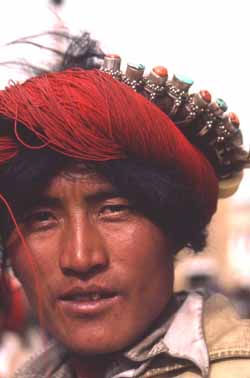
Tibetan_woman_sun_in_eyes2Ever since Tibet first opened to Western tourists in the early 1980s, Kham, the eastern part of Tibet, remained closed. Few hard core travelers tried to bribe their way across in the early years, traveling atop trucks, often needing to keep hidden out of view for most of the journey that could last as long as three to four weeks, freezing, hungry, set to dodge numerous check posts, only to make it through. Getting caught meant getting a heavy fine and instant deportation. Sightseeing was nearly impossible unless the truck driver was willing to stop in the middle of nowhere, or at best perhaps at a small village. Through towns one could pass only by night or early dawn, and only with the utmost cooperation of the truck driver. But even from the back of the truck the scenery was magnificant, and the journey unlike any other.

khampa2rIn recent years as more Chinese tourists ventured to Tibet and started to navigate the Eastern Tibet roads to Sichuan and Yunnan, handful of Westerners have gotten permits as well. Because of protests and calls for Tibetan independence in 2007, Litang and most of Western Sichuan has remained closed since.

Whether travelling the route from Sichuan, from Chengdu via Lithang on to Lhasa, or from Zhongdian in northern Yunnan via Deqin and Markham, the Kham route to Lhasa is simply stunning and an experience not to miss.

Encountering the strong and proud Kampa Tibetans, passing over incredible passes such as Dongda La, Serkhym La or Mila, passing by striking lakes of Ranwu Tso, Rawak Tso, or Draksum Tso, and marveling at glaciers and towering peaks the likes of Namche Barwa is guaranteed to leave one often speechless.

0987Though the route can be done in either direction, Lhasa to Chengdu, Tibet to Sichuan or Sichuan to Tibet, Chengdu to Lhasa, you’ll need considerably more time for this routing. Aside that, this route through Western Sichuan is also more unpredictable, even if you should be able to get a Tibet Travel Permit. This has been even more so a case since the Lhasa and Litang riots of March 2008 and as a result since much of Western Sichuan has been off limits to Westerners, though in recent weeks few Western tourists are getting through.

The third routing, Lhasa to Zhongdian or Tibet to Yunnan, is just as rewarding, can be done in as few as seven days, though more days will allow for more stops and more enjoyable eastern Tibet traverse. For better acclimatization it is advised to travel the route starting from the lower elevations of Yunnan, thus travel Zhongdian to Lhasa.

Khams or Eastern Tibet
Cavaliers of Kham: The Secret War in Central Asia

Leave a Comment more...

Trekking in Ladakh - Part 5

by Alexandra Rosen on Jul.17, 2009, under Alexandra Rosen, India, Ladakh, Trekking in Ladakh, cooking & food, hiking & trekking, remote regions

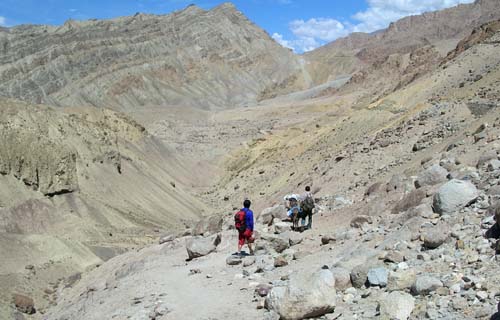
Trekking LadakhWhen I met with the tour director, I questioned him about Numgal, who had been assigned to be my trekking guide. I was assured he was very experienced and that I would enjoy his company. This was welcomed news but the detail I had not foreseen was the trek would be vegetarian. We would have eggs, but no meat or chicken. This made no sense to me since I had been surrounded by sheep and cows for the last five days. He explained that out in the countryside there was no one who was going to slaughter any animal because they were practicing Buddhists and all the Muslims who did this kind of work were only in Leh. The solution seemed simple, we would bring meat with us and even though there were no coolers available in Leh, I was assured whatever we brought could keep for two days.

Numgal and the driver picked me up at 12:00 with the van loaded down with all of our supplies. But before leaving town, we still had to purchase a few items. Numgal wanted to place each of my bags in a large sack which would protect them from the dust and make them easier to load onto the donkeys. He needed the large plastic sacks used to hold rice. Remember nothing goes to waste here, so we had no trouble locating the used sack merchant who was doing a brisk business on the sidewalk. We bought what was needed and looked for the dried fruit seller. We found an old man sitting on the sidewalk behind burlap sacks filled with various fruits and nuts. Ladakh is famous for apricots and even though his apricots were covered in flies, Numgal assured me they would be very delicious when he stewed them up with his special spices. The old man wrapped them up in newspaper as there are no plastic shopping bags in Ladakh and I guess styrofoam is a long way off. Next stop was a small grocery store not much wider than a narrow hallway. The shop keeper sat on a stool in the middle of his shop and was capable of reaching most anything you requested. We stocked up on canned tuna fish and detergent for the dishes and I suggested Pringles. Pringles must be truly global as I have found them most everywhere I have traveled and they are always flavored to suit the local taste. This is India and the flavor was curry. We bought four large bottles of water and Numgal assured me there would be bottled water for sale where we were going. But I was rather disconcerted when I found out that bottled water was not available in small bottles because I had been counting on two small bottles to carry on the trek. Hopefully, I would solve this problem later.

Numgal was ready to leave when I suggested we buy lamb chops, as I could already taste lamb roasted over a wood fire. I wondered why the driver pulled into a parking lot until I saw the lot was lined with butchers in small stalls. These were the Muslim butchers, the only ones who do the “dirty work”. Each butcher displayed the head of an animal, signifying the type of meat he sold. We went to a stall featuring the head of a sheep. The butcher was wearing his skull cap, sitting on a small bed and the size of his shop was a small closet. I told Nugmal we did not want meat from the large carcass which was hanging up, because we wanted baby lamb. I pointed t o my ribs and Numgal asked him for lamb chops. Still sitting on his bed, the butcher rummaged around in a small box, which definitely was not a frozen food locker, and came up with a small leg of lamb. Accepting that, he placed it on his chopping board, smeared with the fat of many other pieces of meat, and hacked it into small pieces. With our parcel wrapped up in newspaper, we were now ready to leave Leh. As we walked away, I noticed two small lamb heads thrown into a bucket but in Buddhist talk, I did not feel I was spiraling down to barbarism.

In Ladakh, the merchants are either Moslems from the Kashmir or Indians. Both groups have had centuries to hone their trading skills while the Ladakhi people remained farmers. However, in the city, since the Ladakhi people were there first, they are the landlords and the Moslems and Indians, who always feel superior to the gentle Ladakhis, are the renters.

HEADING TO THE TREKING SITE

As we left Leh, the driver passed a convoy of Army troops on maneuvers. For the entire two weeks I spent in Leh, along with the mountains and the monasteries, we would continue to see the army presence. At times it appeared that the entire area is one large army outpost. The road leading out of Leh was a perfectly good paved four lane highway, which at times even had lines painted down the middle. But this kind of road is just a teaser because soon we found ourselves on a thinly paved 1 ½ lane road which pared down to a two lane highway, deteriorating on either side, like a decaying tooth. My driver was taking it easy, allowing my heart to stay out of my mouth as vans full of trekkers and Tata trucks passed us at will.

An hour out of town we stop at a bus stop for lunch. There were several small restaurants to choose from and by looking at the cooking pots, you could tell the type of food available. Large bamboo steaming baskets were filled with momos, the Tibetan dumpling, large pots contained noodle soup, and a man with a wok was frying up crispy Indian treats. Since we would be walking for the next five days, I did not want to upset the stomach gods and was very happy to eat from the lunch box the Deskit Guest House had been providing. Nothing could be safer than a hardboiled egg, a boiled potato, something that has been masquerading as bread, and a banana, with its usual dark spots. But they always remembered the salt and pepper.

Second rule of travel, after never take the first room, is to never pass up an offered toilet and always have your pockets stuffed with tissues, as you never know. I followed Numgal behind the bus station where he pointed to a one story brick tower located in the middle of a construction site. Attached to the building was a sign with the word “toilet” and an arrow pointing upward. I thought the direction was wrong but after walking around the building and not finding a door, I realized, as per the tour book, I was to climb up the crudely constructed ladder and seek the toilet on the roof. Just as the tour book described, I found a hole in the middle of the sandy covered floor. Then I got to experience a Ladakhi dry toilet. Once again, nothing here goes to waste and all the deposits are collected and turned into fertilizer.

Back up on the two lane, we still had a two hour drive to our camp site. Soon I noticed two ladies walking along the road spinning their prayer wheels. When I have a driver and guide and lots of space, I am always willing to pickup people walking, especially women. We stopped and offered them a ride. The younger woman was hesitant but after Numgal’s gentle coaxing and a not too subtle push from the older woman, the two women made themselves very comfortable in the back of the van. They accepted the food left in my lunch box. They enjoyed the juice and the bread, but had a little difficulty eating the candy bar because they did not possess two opposing teeth. I asked Numgal to find out their story and where they were going. This was a mother-in-law and she was taking her daughter-in-law to a monastery to make an offering so that she would finally have a grandchild, preferably a boy. The mother-law-law said she was tired of waiting. They had tied wishes to trees, they had visited a shaman, and this was the last opportunity. Maybe we earned a little merit as we drove them for around 1 ½ hours before depositing them at the monastery. Thirty minutes later, we pulled into the camp site. Dorje, the donkey man, was there waiting for us with his four donkeys tethered to the fence.

LadakhAT THE CAMP SITE

The camp site was actually a gravel parking lot in front of a guest house and when given the option of sleeping in a tent or in one of their rooms, I opted for the room, especially since there would be enough opportunity later for sleeping in a tent. Leaving Numgal and Dorje in the parking lot, an old woman, dressed in traditional clothing, led me to my room. I was happy to have the room and this was not the kind of place to refuse the first room hoping for better. The charge was four dollars for the night and one dollar extra for breakfast, but it was agreed that Numgal would provide breakfast. This was a family run guest house, catering to trekkers and similar ones can be found all over Ladakh. A small sign advertised en suite bathrooms and even though it was Turkish style (a squatter in the floor) it was inside and I was not much troubled by the sink, which was not quite attached to the wall and lacked faucets, because I knew the shower by bucket was just a boiler away. In lieu of electricity, I found an assortment of used candles. I located my flashlights and laid out my sheet, blanket, and pillow, ready for an evening without much light.

Dinner was scheduled at 7:30 in the parking lot. This gave me plenty of time to read and make notes on the day’s happenings. Also, I was interested in meeting the women whose laundry was drying on the clothes line. The sun was too hot to allow me to sit in the garden and I retreated to the shade of the porch. The prayer flags were fluttering from the roof as the breeze was sending prayers to heaven and a shaggy dog was content to sleep at my feet. The only sound was the tinkling of a wind chime and once again I silently slipped into the arms of a serene moment. At 4:00 I looked up to see Numgal approaching. He was carrying a large tray, announcing it was time for tea time. What a surprise, tea on the veranda, by the side of the garden, even if it was a little over grown. The tea pot was full of loose tea and he had provided a proper tea strainer, a bowl of sugar, a tea cup, and a plate of cookies which he had artfully arranged. The surroundings may not have looked five star, but the service certainly was.

The women, who belonged to the laundry returned , and carrying my plate of cookies, I went up to introduce myself. Suzy, Doris, and another Doris were from Switzerland and had been trekking by themselves for the last five days, sleeping in guest houses. I marveled at the large backpacks they were carrying. They told me they had an easy day because they had met Dorje on the trail and the donkeys had carried their packs. I asked them how they were doing without a guide. The reply was they had a map and when they were not sure which path to take, they just guessed. They had been visiting the nearby monastery and saw two women praying before a large Buddha. I suspected these were the two women we had dropped off. We swapped travel stories and impressions of Ladakh and I think they enjoyed my conversation as they were getting a little bored with each other. They were eating dinner in the guest house and we agreed I would join them after my dinner.

DINNER AT CHEZ NUMGAL

Numgal had spent the day setting up his “field kitchen” and even though I did not smell the longed for aromas of lamb sizzling on an open fire, I had no idea of the experience awaiting me. Both men had changed their shirts, and like a maitre’d in a fine restaurant, Dorje ushered me to a table and chair, which they must have borrowed from the guest house. They had also borrowed a table cloth, placed a flower in a drinking glass, and lit several candles.

The first course was a tasty split pea soup, made from a packaged soup mix that Numgal had enhanced with various spices. Then he presented his lamb dish. He had turned the chunks of meat into a fantastic stew, accompanied by a thick tomato, mushroom sauce. There was a side dish of dal (lentils) served over rice plus sauteed cauliflower. For dessert, he had prepared the apricots, and he was right, they were very delicious. Dinner was concluded with a cup of cardamom tea. The evening was borderline surreal. I had enjoyed one of the best lamb stews I have ever had, a definite five star meal with five star service, under a sky filled with stars, in a gravel parking lot cum construction site, somewhere in up country Ladakh. Whatever Harvey was searching for, I think I found part of it that night. As far as merging time and space, I had no need to know the day of the week and my location, as pinpointed on a map, seemed irrelevant. The honesty and sincerity of the two guides, who could not do enough to make me comfortable, added to the wonder of the moment. If this kept up, I would soon be hearing the Buddhist sound of the void.

Even though Numgal started off shy and proved himself not much of a driver when he pulled out in front of that truck, he certainly excelled in the countryside and throughout the remaining week he was always smiling and maintained his sense of humor. Every meal Numgal cooked was exceptional and he did not have to worry about reigning in his culinary talents because early on I told him to cook the way he wanted because I enjoyed spicy food. His cooking equipment was limited to an old style pressure cooker, two pots, and a frying pan. His stove consisted of a one burner unit powered by kerosene. He proved to be a magician with vegetables, even those that would develop black spots, and what was not finished at dinner was artfully turned into something else for a later meal. Before he started cooking, he would line up his supply of spices, surrounding himself with boxes of salt, pepper, cumin, turmeric, coriander, and marsala mix, along with garlic and ass orted herbs, which he could only describe in his language. We did not have any tomatoes but he was able to turn Magi ketchup into delicious sauces. Numgal spoke enough English and understood more than he could speak but we never seemed to have any communication problems. Since I was in Buddhist country, I can say now that his skills unfolded like the petals of a lotus, and at the time I had no idea how important he was going to become to my well being.

Dorje appeared to be a happy man, always smiling and treating me as the honored guest. He brought his own small rolling pin and turned flour and water into delicious puris and chapatis. He was like the side kick and along with taking care of his donkeys, he helped Numgal and cleaned up after dinner. Dorje never stopped talking and telling jokes. Maybe this was a little tiring for Numgal, but Dorje probably needed to talk to someone other than his donkeys.

A VISIT TO A LADAKHI HOUSE

After dinner, I left Numgal straightening up and Dorje doing the dishes with water from a house. I was too far into this to worry about the quality of the water. Suzy, Doris, and Doris had invited me to join them for their dinner. We went to the family’s main house and were graciously received by a beautiful young woman, wearing a flight jacket, which I thought a little strange. We entered into a large downstairs room which was considered their ceremonial room, the place where they conducted religious ceremonies, weddings, coming of age parties, etc. We sat on banquettes with low tables in front of us, similar to that at the Deskit Guest house, and quickly became comfortable among the many pillows and bolsters. As in all traditional houses, an entire wall was dedicated to the family collection of cooking pots, teapots and bowls, large samovars, and assorted brick-a-brac, collected over the years. She said up to 500 people would be invited to their parties which included extended family and friends. The most unusual object was a plastic clock in the shape of a chorten(stupa) and on the hour it chanted out the mantra dedicated to Avalokiteshvara, god of compassion and mercy, om mani padme om, hail to the jewel in the lotus. Of course made in China and when I asked her if this was a way to earn merit, she laughed and said a little.

While we watched her making dough from barley flour and water, which would be boiled and turned into a kind of spretzel, she told us the story of her life. She was born in this area and had been able to go to Delhi to attend flight school. She wanted to be a pilot. Later her parents informed her they had arranged for her to be married to a local boy. Even though she was almost finished with her studies, she had to be a dutiful daughter. Abandoning her dream, she returned home. She had been married for five years. The husband was in Leh running a tour company and a computer store and even though she had almost made it out of there, she was now left behind to run the guest house owned by her in-laws. Her mother-in-law was a retired oracle. She was able to see into the future and when paid the right price, could offer insights from the beyond. As per the book I was reading, there are people in Ladakh who are able to go into a trance, make contact with the other side, and bring back information regarding the future or insights on how to deal with the present. When in a trance, they would be able to speak perfect Tibetan and of course not remember the language or anything else when the trance was over. Since she had her daughter-in-law to rely on, she was able to retire from her profession, claiming it was too exhausting. The father-in-law, when not driving a truck, had been an astrologer. But he too had retired from work and was content to cultivate his garden.

She was completely charming and it was a delightful evening. I said goodbye to the Swiss ladies. Coincidentally, we were all departing from Delhi on the same flight to Frankfurt and I promised to look for them at the gate. Returning to my room, I was surprised by the knock on the door. Opening the door, I found our dinner hostess offering me a bucket of hot water. The charm just continued. With all flashlights and candles burning, I became relatively clean. Wrapping up in my sheet and blanket, sleep found me just as soon as my head hit my Walgreen pillow. Tomorrow would we would start our trek.

Ladakhi women

Leave a Comment :, , , , , , , , , , , , , , , , , , , , , , , , , , , , , , , , , , , , , , , , , , , more...

House architecture of Lhomi Tibetans of upper Arun River, Eastern Nepal Himalayas

by tb on Jun.17, 2009, under Himalayas Architecture, Nepal, Places to See, art & architecture, remote regions

Trekking in Eastern Nepal Himalayas is once again possible and venturing into the upper reaches of the Arun River offers an insight into the lifestyle of the Lhomi Bhote, the Tibetan population group that occupies this remote part of eastern Nepal. The diversity of house types built by the Tibetan population groups in the Nepal Himalaya from one area to the next is quite fascinating. The Lhomi Bhote, whose villages are found as far north as where Arun breaches the high Himalayan massif, build themselves houses that range from all bamboo and bamboo matting type of structures elevated on stilts of tree trunks or stones, to all stone houses with wooden shingles, or even houses of solid timber.Lhomi monkCompact Lhomi village of lower Arun river valley


The Arun River, one of the greatest Himalayan Rivers, originating in Tibet, breaks through the high Himalayan range at an altitude of only little more than 4,000 feet above sea level.  High above its deep gorge, affected significantly by monsoonal rains, are situated the villages of the Lhomi Tibetans. The Lhomi villages are compact settlements, sited on broad ledges or on steep slopes. 

Lhomi womanBuddhist stupa and mani wall in a Lhomi village


The houses in the villages built in the lowest elevations, around 5,200 feet above sea level, are constructed on stone stilts or on all-stone foundations. The walls are made of stone or quite often of woven bamboo, which is also used exclusively in the covering of the roofs.

Splitting bamboo into strips to weave a roof mattingStone and bamboo matting house of Lhomi Tibetans


In higher elevations, stone begins to predominate in the house architecture. In the highest situated Lhomi villages, in altitude over 8,000 feet, however, timber now appears, and at times solid timber houses erected on stone stilts may be found.  Bamboo, which is cut in typical stalks that are split into thin strips then woven into mats, continues to be utilized in the coverage of the roofs.  Lhomi settled high above the Arun river

Lhomi Buddhist lama

Lhomi Bhote of upper Arun river valley


The Lhomis believe their ancestors came from Tibet.  Actually, Lhomi is not a tribal name, but a Tibetan expression for “lowlanders”, a name which the people apply to themselves in view of the fact that the region of their present habitat is located to the south of Tibet proper.  More correctly, the Lhomis of the upper Arun are known as the Kar Bhote.  

Post and beam construction of Lhomi timber house type

Solid timber house of the Lhomi Tibetans


They are self-sufficient farmers with trade playing only a minor role in their lives.  The style of their dress is similar to other Tibetan population groups living in the Nepal Himalaya, although the generally warmer climate of their native region enables them to go barefoot for the greater part of the year. 

Solid timber house of the Lhomi TibetansLhomi timber houses surrounded by millet fields

In addition to wearing unique small cloth caps embellished with Indian silver coins, the Lhomi women, as most Tibetan women like to adorn themselves with silver ornaments and necklaces of coral, amber and turquoise beads.

Lhomi village, upper Arun


The Lhomis still claim to be of the Buddhist religion, however, their monasteries are in a tragic state of disrepair, Buddhist Lamas are few, and the contact with Tibet, the source of their religion, has been broken since its 1959 takeover by the Chinese. Well rooted in their religious practice are elements of a pagan form of a pre-Buddhist religion, which includes animal sacrifices, and worship of spirits and patron deities. Nevertheless, nearly every village harbors several chortens, Buddhist stupas, and mani walls which bear testimony to this region once being a place where Buddhism flourished.

1 Comment :, , , , , , , , , , , , , , , , , , , , , , , more...

Travel in Indonesia: fascinating Tana Toraja culture of Central Sulawesi

by ph on May.20, 2009, under Asia, Destinations, Indonesia, Sulawesi, Vernacular Architecture, art & architecture, island hopping, man-made wonders, remote regions, unique islands

Massive structure of a Toraja houseFront facade of a Toraja houseTraditional house style in Central Sulawesi, Tana TorajaGranaries in a Toraja village

Structural members of a Toraja roofIn the remote parts of Central Sulawesi of the Indonesian archipelago, an-odd shaped island resembling a hunched-over letter “k”, under the Dutch known as Celebes, there can be found a saddle-roof style house type built on piles. Depicted on Dong Son drums as far back as 500BC-AD100, its origin suggests being of mainland Southeast Asia. The region is known as Tana Toraja, or Torajaland, and the characteristic house style is referred to as “tongkonan” – a traditional ancestral house of the Toraja people that inhabit these mist-shrouded valleys, averaging some 3000 feet above seas level. Visiting Sulawesi’s Toraja region is easily done from Bali and the experience is always a highlight of travel in Indonesia.

Sitting under a granaryToraja house roofOf tongue-and-groove construction, using no nails, bolts or other metal fasteners, the traditional houses are built on solid tree trunk piles high above the ground to safeguard against rodents, snakes and dampness of the tropical ground. It is the massive roofs, covered in a layered bamboo, today often by corrugated iron, that immediately catch one’s attention. The research shows that these proto-Malay peoples have originated from Cambodia. Their own lore and legends claim that their ancestors crossed the high seas to the north, suggesting they embarked off the coast of Southeast Asia. Their stories tell of storm having diverted their boats to shores of Sulawesi, thrown ashore the people used them as roofs.

s93zFact is the characteristic house type Toraja build over centuries developed only in the interior mountains that surround fertile plateaus and valleys where they live. Due to the remoteness of the region, even today some seven hours by road to the main urban port of southern Sulawesi, the mountains have protected lifestyle and customs, which have changed relatively little to this day.

A legend has it that the roof shape as well as the general shape of the house is patterned on the ships on which they sailed from their ancestral homeland. On another hand, closer look at their culture reveals worship of buffalo, which is a symbol of fertility, strength, and a protection from evil, and its horns decorate the gables of Torajan houses, hence the other theory has it the roof shape is that of a buffalo’s horn.

Whatever the shape’s origin the houses truly look as if they could sail, their sweeping roofs, especially when constructed closely together, the front of the house facing north, the direction of the ancestral homeland, look like ships moored at port. Opposite the houses are rows of granaries, too constructed in the same shape and on piles, often lavishly decorated. The uniform site plan of villages, compact settlements of freestanding structures set in a row, are precisely laid out as if based on well-thought out principles of a subdivision design.

 Ceiling inside a Toraja houseThe house type is always elevated off the ground but in some villages the front of yet longer and broader roof is supported by a massive pillar ever more so giving the house the appearance of a ship.

The interior of the house is quite simple, consisting usually of three rooms - a living area, kitchen and sleeping quarters. As there is no chimney soot of the large fire pit cooking area covers the beams and rafters.

People of Toraja

Interior of a Toraja house

Kitchen in a Toraja house

Horns of buffalo on a Toraja houseEvery house, typically on the front facade but often also on the side of the house, adorn horns of buffalos. The family status is usually shown by the number of horns mounting the house, the more there are the higher the merit and status for the family, attesting to many sacrifices, feasts and ceremonies performed by the family to which many guests have been invited.

In the ancient times, the old, “adat” ceremonies and animistic rites, practiced by the Toraja until the arrival of Christian missionaries, not only buffaloes were sacrificed but people as well. As in many other cultures of the Indonesian archipelago, from Sumatra to Timor, headhunting was part of animistic practices. Its existence shows relationship to headhunting practices of ancient cultures of South and Southeast Asia, further substantiating the roots of origin of the island cultures, whether of Indonesian or Philippine archipelago. Although buffalo and pig sacrifices have replaced human heads and the animistic religion has for the most part been diluted, reasonably strong adat practice still continues to this day and is practiced by about 25% of the Toraja people. Much of the traditional animistic practices take place during the funeral ceremonies called the Feast of the Dead. The practice is sustained by the Toraja inherent belief in afterlife, called Puya, or the Land of the Dead, where everyone is believed will live under the same conditions as he or she did on earth, a belief that spurs every Torajan to attain as much wealth as possible during his lifetime. Another belief of note is that the Toraja people believe the souls of animals will follow their masters into heaven, thus the buffalo sacrifice is in a way not perceived as taking of life as such but rather as an act which is only a temporary state of parting between man and beast and the two will reunite once again at death.

Side of a Toraja house adorned with buffalo horns


Decoration on a Toraja granaryAll Toraja houses are richly decorated in a maze of geometric ornamentation in ochre-red, black and white as well as a profusion of symbolic carvings representing aspects of ancestral worship, known as Aluk Todolo. Traditionally people were only allowed to depict motives characteristic of their social status or cast, whether that of the Tokapua or the noblemen, the Tomokaka or a middle-class tradesmen, or the Tobuda, the commoner, usually a farmer. Today people add designs expressive of their lifestyle as well as profession.

sul6z

Decoration on a Toraja houseDecoration on a Toraja house


Decoration on a Toraja house


Carving on a Toraja house depicting scene from owner's millitary serviceCarving of a daily life scene on a Toraja houseBuffalo carvings on a Toraja houseToraja house decorationsDecorations on a Toraja house   s13z

Most Toraja people are Christians, both Catholics and Protestants, and the church spires dot the horizon of the villages. Only about ten percent are Muslim, and in fact Muslim religion dominates the coastal areas as well as many deep valleys surrounding the Toraja region as such. All in all Toraja continue to practice highly ritualistic religious ceremonies including the rites of fertility, marriage, birth and death.

Christian churche in a Toraja villageRice fields surrounded by lush jungle and mountains of Torajaland Tau-tau effigies of the deceased in Toraja

 s159zThe Torajans believe that when a person dies, the soul leaves the body but remains restless until the burial ritual has been completed. Often a time much of family’s wealth can be spent on staging the finest, most elaborate funeral they can afford, a strange blending of solemnity and celebration. Today the Toraja may bury their dead in the ground but the traditional burial was by placing the body in a casket that was taken into a small structure shaped like their house before being moved to its final resting place inside a cliff-side grave. The caskets were inserted inside cave-like chambers although often left to protrude on specially constructed balconies high above the valley floor. As over time many caskets fell, the ground below is littered with bones and skulls. On the balconies are displayed “tau-tau”, the wooden effigies of the deceased, typically set in rows as puppets they stand gazing over the countryside.

There is definitely more to Indonesia than Bali and visiting Sulawesi and Torajaland should not be missed. On your next trip to Bali or elsewhere in Indonesia include Sulawesi in your itinerary!

Leave a Comment :, , , , , , , , , , , , , , , , , , , , , , , , , , more...

Looking for something?

Use the form below to search the site:

Still not finding what you're looking for? Drop a comment on a post or contact us so we can take care of it!