Top Travel Leads

man-made wonders

Dzong, the fortress style of architecture of Bhutan
by tb on Oct.09, 2009, under Bhutan, Bhutan architecture, man-made wonders

Inclined walls of the Punakha Dzongbhu24

bhu34Those with profound interest in architecture and decorative arts will find Bhutan a truly fascinating and inspirational place to visit. The architecture of Bhutan carries overtones of design features patterned on those of Tibet and the Himalayas in general, however, in Bhutan they developed clearly Bhutanese characteristics.

While Tibetan fortress style of architecture permeates the house, temple and monastic style of architecture from Ladakh in the Western reaches of the Himalayas to Kham region of Eastern Tibet, and is found north as well as south of the principal chain of the High Himalayas, in Bhutan the dzong, the fortress style of architecture, stands in a category of its own.

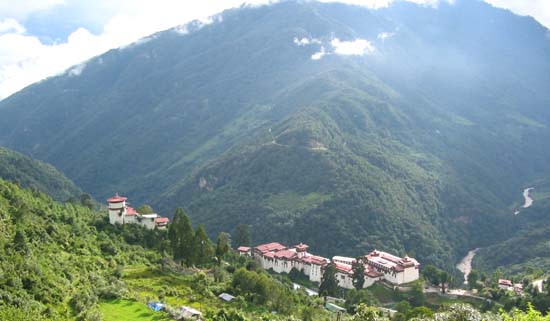
Massive in style, Bhutanese dzongs are essentially structures containing administrative offices of the government as well as temples and housing quarters for resident monks. Surrounding interior courtyards, the dzong exterior walls are typically slightly inclined in style of European medieval castles.

Dzongs of Paro, Thimphu, Punakha, Trongsa, Jakar, Trashigang, Mongar, or Simtoka Dzong near Thimphu all impress in their layout, lavishly decorated woodwork within, display striking carved posts and beams, nooks and niches harboring votive images, and above all by being sited in commanding positions, either at the confluence of rivers, on hilltops or spurs.

bhu56Trongsa Dzong

bhu32Wangdi Dzong

bhu29Temple within interior of a dzong

bhu28Intricate decorations on a dzong couryard building

bhu19Punakha Dzong

bhu17Thimphu Dzong

bhu25Exterior wall, window and main entrance balcony of the Punakha Dzong

VISIT BHUTAN - Bhutan Travel, Festival,
Trekking, Bicycling and Bird Watching Tours

Leave a Comment :, , , more...

Taj Mahal & Fatehpur Sikri, Must See Gateway to Magic Rajasthan

by ph on May.28, 2009, under Asia, Destinations, History & Culture, India, Journeys of a Lifetime, Tours, UNESCO sites & monuments, art & architecture, man-made wonders


taj-mahalMany first time vistors to India crave to visit the legedary Taj Mahal and do so often as only a daytrip from New Delhi, ariving there at midday when sun is high and the grandeur of this remarkable site is diminished. It’s a shame as Taj must been seen at least twice, once in the late afternoon when shadows are long and next at sunrise.

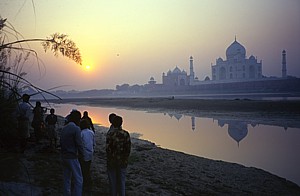
Taj Mahal at sunsetA world heritage site, UNESCO described Taj Mahal as “the jewel of Muslim art in India”. Often considered the pinnacle of Mughal art, the Taj was built by Emperor Shah Jahan for his beloved wife Mumtaz Mahal. There are few words that can describe the spleandor of this monument, hence viewing it at the ideal times of the day are an absolute must to soak in its full magnificance .

After early morning visit of Taj Mahal it’s best not to return to Delhi but continue to Fatehpur Sikri. Only one hour driving time away from Agra, Fatehpur Sikri was the 16th century capital of the Mughal rulers and the great Mughul Emperor Akbar had intended it to be the grandest capital city of the the world. Built entirely of red sandstone he came close to succeeding and Fatehpur Sikri served as his capital for 15 years until it was abandoned after his death in 1585 due to water scarcity in the area.

fatehpur-sikriUndisputedly the magic of Rajasthan accounts for some of the most memorable impressions of India and Taj Mahal and Fatehpur Sikri are but gateways to what lies ahead. From Fatehpur Sikri one can proceed to Bharatpur, only one hour further down the road, and beyond will lure such sites as Ramathra Fort, Ranthambore National Park, Bundi, Pushkar, Jaipur, Jodhpur, Bhainsrorgarh, Udaipur and much more.

1 Comment :, , , , , , , , , , , , , , , more...

Travel in Indonesia: fascinating Tana Toraja culture of Central Sulawesi

by ph on May.20, 2009, under Asia, Destinations, Indonesia, Sulawesi, Vernacular Architecture, art & architecture, island hopping, man-made wonders, remote regions, unique islands

Massive structure of a Toraja houseFront facade of a Toraja houseTraditional house style in Central Sulawesi, Tana TorajaGranaries in a Toraja village

Structural members of a Toraja roofIn the remote parts of Central Sulawesi of the Indonesian archipelago, an-odd shaped island resembling a hunched-over letter “k”, under the Dutch known as Celebes, there can be found a saddle-roof style house type built on piles. Depicted on Dong Son drums as far back as 500BC-AD100, its origin suggests being of mainland Southeast Asia. The region is known as Tana Toraja, or Torajaland, and the characteristic house style is referred to as “tongkonan” – a traditional ancestral house of the Toraja people that inhabit these mist-shrouded valleys, averaging some 3000 feet above seas level. Visiting Sulawesi’s Toraja region is easily done from Bali and the experience is always a highlight of travel in Indonesia.

Sitting under a granaryToraja house roofOf tongue-and-groove construction, using no nails, bolts or other metal fasteners, the traditional houses are built on solid tree trunk piles high above the ground to safeguard against rodents, snakes and dampness of the tropical ground. It is the massive roofs, covered in a layered bamboo, today often by corrugated iron, that immediately catch one’s attention. The research shows that these proto-Malay peoples have originated from Cambodia. Their own lore and legends claim that their ancestors crossed the high seas to the north, suggesting they embarked off the coast of Southeast Asia. Their stories tell of storm having diverted their boats to shores of Sulawesi, thrown ashore the people used them as roofs.

s93zFact is the characteristic house type Toraja build over centuries developed only in the interior mountains that surround fertile plateaus and valleys where they live. Due to the remoteness of the region, even today some seven hours by road to the main urban port of southern Sulawesi, the mountains have protected lifestyle and customs, which have changed relatively little to this day.

A legend has it that the roof shape as well as the general shape of the house is patterned on the ships on which they sailed from their ancestral homeland. On another hand, closer look at their culture reveals worship of buffalo, which is a symbol of fertility, strength, and a protection from evil, and its horns decorate the gables of Torajan houses, hence the other theory has it the roof shape is that of a buffalo’s horn.

Whatever the shape’s origin the houses truly look as if they could sail, their sweeping roofs, especially when constructed closely together, the front of the house facing north, the direction of the ancestral homeland, look like ships moored at port. Opposite the houses are rows of granaries, too constructed in the same shape and on piles, often lavishly decorated. The uniform site plan of villages, compact settlements of freestanding structures set in a row, are precisely laid out as if based on well-thought out principles of a subdivision design.

 Ceiling inside a Toraja houseThe house type is always elevated off the ground but in some villages the front of yet longer and broader roof is supported by a massive pillar ever more so giving the house the appearance of a ship.

The interior of the house is quite simple, consisting usually of three rooms - a living area, kitchen and sleeping quarters. As there is no chimney soot of the large fire pit cooking area covers the beams and rafters.

People of Toraja

Interior of a Toraja house

Kitchen in a Toraja house

Horns of buffalo on a Toraja houseEvery house, typically on the front facade but often also on the side of the house, adorn horns of buffalos. The family status is usually shown by the number of horns mounting the house, the more there are the higher the merit and status for the family, attesting to many sacrifices, feasts and ceremonies performed by the family to which many guests have been invited.

In the ancient times, the old, “adat” ceremonies and animistic rites, practiced by the Toraja until the arrival of Christian missionaries, not only buffaloes were sacrificed but people as well. As in many other cultures of the Indonesian archipelago, from Sumatra to Timor, headhunting was part of animistic practices. Its existence shows relationship to headhunting practices of ancient cultures of South and Southeast Asia, further substantiating the roots of origin of the island cultures, whether of Indonesian or Philippine archipelago. Although buffalo and pig sacrifices have replaced human heads and the animistic religion has for the most part been diluted, reasonably strong adat practice still continues to this day and is practiced by about 25% of the Toraja people. Much of the traditional animistic practices take place during the funeral ceremonies called the Feast of the Dead. The practice is sustained by the Toraja inherent belief in afterlife, called Puya, or the Land of the Dead, where everyone is believed will live under the same conditions as he or she did on earth, a belief that spurs every Torajan to attain as much wealth as possible during his lifetime. Another belief of note is that the Toraja people believe the souls of animals will follow their masters into heaven, thus the buffalo sacrifice is in a way not perceived as taking of life as such but rather as an act which is only a temporary state of parting between man and beast and the two will reunite once again at death.

Side of a Toraja house adorned with buffalo horns


Decoration on a Toraja granaryAll Toraja houses are richly decorated in a maze of geometric ornamentation in ochre-red, black and white as well as a profusion of symbolic carvings representing aspects of ancestral worship, known as Aluk Todolo. Traditionally people were only allowed to depict motives characteristic of their social status or cast, whether that of the Tokapua or the noblemen, the Tomokaka or a middle-class tradesmen, or the Tobuda, the commoner, usually a farmer. Today people add designs expressive of their lifestyle as well as profession.

sul6z

Decoration on a Toraja houseDecoration on a Toraja house


Decoration on a Toraja house


Carving on a Toraja house depicting scene from owner's millitary serviceCarving of a daily life scene on a Toraja houseBuffalo carvings on a Toraja houseToraja house decorationsDecorations on a Toraja house   s13z

Most Toraja people are Christians, both Catholics and Protestants, and the church spires dot the horizon of the villages. Only about ten percent are Muslim, and in fact Muslim religion dominates the coastal areas as well as many deep valleys surrounding the Toraja region as such. All in all Toraja continue to practice highly ritualistic religious ceremonies including the rites of fertility, marriage, birth and death.

Christian churche in a Toraja villageRice fields surrounded by lush jungle and mountains of Torajaland Tau-tau effigies of the deceased in Toraja

 s159zThe Torajans believe that when a person dies, the soul leaves the body but remains restless until the burial ritual has been completed. Often a time much of family’s wealth can be spent on staging the finest, most elaborate funeral they can afford, a strange blending of solemnity and celebration. Today the Toraja may bury their dead in the ground but the traditional burial was by placing the body in a casket that was taken into a small structure shaped like their house before being moved to its final resting place inside a cliff-side grave. The caskets were inserted inside cave-like chambers although often left to protrude on specially constructed balconies high above the valley floor. As over time many caskets fell, the ground below is littered with bones and skulls. On the balconies are displayed “tau-tau”, the wooden effigies of the deceased, typically set in rows as puppets they stand gazing over the countryside.

There is definitely more to Indonesia than Bali and visiting Sulawesi and Torajaland should not be missed. On your next trip to Bali or elsewhere in Indonesia include Sulawesi in your itinerary!

Leave a Comment :, , , , , , , , , , , , , , , , , , , , , , , , , , more...

Time to visit Luang Prabang is now

by TomBel on Feb.28, 2009, under Asia, History & Culture, Laos, UNESCO sites & monuments, art & architecture, man-made wonders, temples & monasteries, unique towns

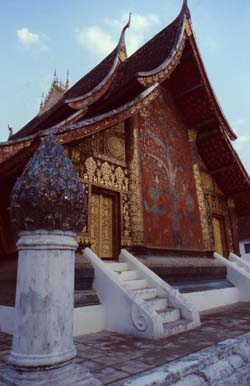
Wat Xieng Thong temple in Luang Prabang, LaosFollowing end of Vietnam – American war and its postwar alignment with North Vietnam’s communist system of government, Laos fell into obscurity. With the fall of Berlin Wall and dismantling of Soviet Union, Laos as Vietnam slowly opened its borders to international tourism. Vientiane, the capital, became the first target as a result of easy access from well-developed Thailand to the south. But it was not long before tourists started to venture up to north central Laos to visit Luang Prabang, the former capital of Lane Xang, the first independent Lao kingdom founded in the 14th century, a role it shared for centuries with Vientiane right up to the communist takeover of the country in 1975. Surrounded by mountains, a stunning potion on the banks of the Mekong River, some three dozen Buddhist temples, sizeable monk community, touch of former French colonial architectural influence and lively hill tribe market it was not long that Luang Prabang’s inherent charm and significant monuments were noticed by the United Nations Educational, Scientific and Cultural Organization and in 1995 added to its World Heritage list.

Buddhist temple in Luang PrabangDue to its remote location overland access to Luang Prabang from Vientiane is even today no easier then fifteen years ago. Although paved but narrow and winding, at times in the past its traffic caught in crossfire between the government troops and the Hmong insurgents, taking some 10 to 12 hours of stressful driving to reach from Vientiane, road access to Luang Prabang was always dismissed as viable alternative to spur tourism. For the town to attract steady stream of tourists to provide for access by air was the best approach. Whereas in the first years of operation the airport was considered dangerous to land on, it has gone through improvements and as a result today Luang Prabang seees nearly million tourists per year, most from neighboring Thailand.

Needless to say increased tourism brings more income and more development although not all necessarily for the better. While the historical core of Luang Prabang must abide by strict guidelines set forth by UNESCO to retain its charm and preserve its cultural continuity, the development focuses on amenities and surroundings. Per recent news Korean investors are proposing a major 3000-hectare commercial development, christened Diamond City, in the total of some 2-billion dollars, a staggering amount for this outlying region of Asia. Said to include tourism, financial and recreational services, the project undoubtedly will alter the peaceful ambiance of the town and its surroundings forever.

Boats on Mekong river at Luang PrabangWhereas even fifteen years ago when Luang Prabang first received its designation as UNESCO monument handful of local cargo barges sailed downstream Mekong all the way to Vientiane and no river craft plied the river specifically catering to tourists, other than handful of small boats run by local fishermen, the current river offerings include dinner cruises, scheduled river trips to traditional villages for dinner, music and dance cultural shows and elephant rides. While Luang Prabang has not yet progressed to becoming the travel supermarket town of Dali or Lijiang in Yunnan to the north, with China Lavishly decorated temples and stupas in Luang Prabangnow allowing its citizens to travel ever more freely abroad including Laos, and with the bridge across the Mekong between Chiang Khong in northern Thailand and Houayxay in Laos, being the final link in a north-south road system through the Mekong region between Yunnan, Laos and Thailand, the main road completed in Fall of 2008 and the bridge scheduled to be completed by 2011, Luang Prabang will undoubtedly see more influx of overland visitors with hordes of Chinese package tour busses likely in the forefront.

While the Royal Palace in Luang Prabang, completed only in 1909 in Lao and French Beaux Arts style during the French colonial era for King Sisavang Vong and his family is one of the main Luang Prabang’s drawing cards, the impressive Wat Xieng Thong temple, located on the northern tip of the town’s peninsula at the confluence of the Nam Khan and Mekong Rivers, constitutes the highlight of the row of temples and monasteries that lead up to it. Although under the guidelines of UNESCO the historic core of Luang Pranga is assured to retain its temple ambiance, with more development in town’s surroundings and more tourists to come, time to see Luang Prabang is now before it will become another Venice or Prague.

Leave a Comment :, , , , , , , , , , , , , , , , , , , , more...

Magic of Taj Mahal, Agra, India

by TomBel on Dec.28, 2007, under India, Places to See, UNESCO sites & monuments, man-made wonders, temples & monasteries

Taj Mahal, the wonder in white marble

At dawn visit the Taj Mahal in Agra, the most extravagant monument ever built for love. This wonder in white marble was built by the Mughal Emperor Shah Jehan in memory of his wife Mumtaz in the year 1631. It took 22 years and 20,000 craftsmen and laborers to complete the construction of this historic tomb of Mumtaz Mahal, the chosen one of Emperor Shah Jehan.
There is more to this country than Taj Mahal, Himalayas or the sacred river Ganga; INDIA is an opportunity to explore the realms of ones spiritual being , of reaching out to the unknown, to discover the deeper truth that is life.
There is no other country on earth that can exude such a remarkable variety of cultures and landscape. Explore the possibilities of seeing the magic of India on a tailor-made India private tour! As the Mahabharata says, “What is here, may be elsewhere, but what is not here is nowhere”.

Leave a Comment :, , , , , , , , , , , , , , , , , , , , , more...

Looking for something?

Use the form below to search the site:

Still not finding what you're looking for? Drop a comment on a post or contact us so we can take care of it!