
Top Travel Leads

Bhutan

Dzong, the fortress style of architecture of Bhutan

by tb on Oct.09, 2009, under Bhutan, Bhutan architecture, man-made wonders

Inclined walls of the Punakha Dzongbhu24

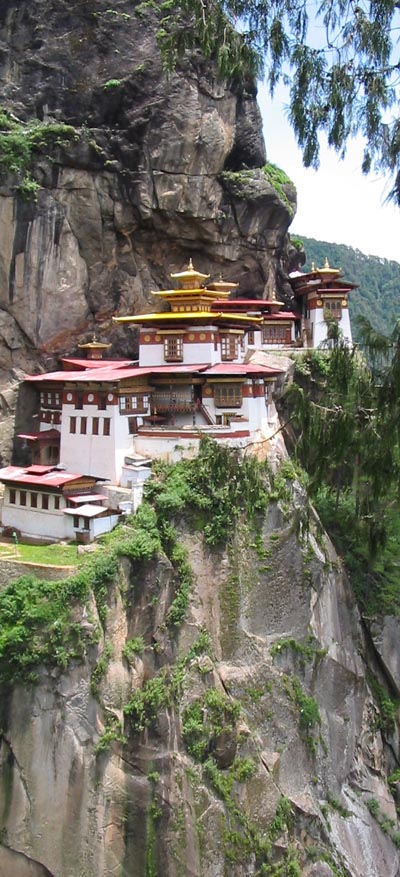
bhu34Those with profound interest in architecture and decorative arts will find Bhutan a truly fascinating and inspirational place to visit. The architecture of Bhutan carries overtones of design features patterned on those of Tibet and the Himalayas in general, however, in Bhutan they developed clearly Bhutanese characteristics.

While Tibetan fortress style of architecture permeates the house, temple and monastic style of architecture from Ladakh in the Western reaches of the Himalayas to Kham region of Eastern Tibet, and is found north as well as south of the principal chain of the High Himalayas, in Bhutan the dzong, the fortress style of architecture, stands in a category of its own.

Massive in style, Bhutanese dzongs are essentially structures containing administrative offices of the government as well as temples and housing quarters for resident monks. Surrounding interior courtyards, the dzong exterior walls are typically slightly inclined in style of European medieval castles.

Dzongs of Paro, Thimphu, Punakha, Trongsa, Jakar, Trashigang, Mongar, or Simtoka Dzong near Thimphu all impress in their layout, lavishly decorated woodwork within, display striking carved posts and beams, nooks and niches harboring votive images, and above all by being sited in commanding positions, either at the confluence of rivers, on hilltops or spurs.

bhu56Trongsa Dzong

bhu32Wangdi Dzong

bhu29Temple within interior of a dzong

bhu28Intricate decorations on a dzong couryard building

bhu19Punakha Dzong

bhu17Thimphu Dzong

bhu25Exterior wall, window and main entrance balcony of the Punakha Dzong

Leave a Comment :, , , more...

Punakha Dromchoe festival of Bhutan

by tb on Sep.29, 2009, under Bhutan, carnivals & festivals, temples & monasteries

After a beautiful drive through the terraced landscape, river valleys, traditional Bhutanese architecture and chortens (domed monument) we reach Simtokha Dzong, the oldest Dzong in Bhutan (built in 1629). From here, the road winds through pine forests and small villages, and passes by more chortens and prayer flags before heading up to Dochula Pass (10,000′), the first of four passes of the trip. The prayer flags on mountain slopes, bridges and high passes, transmit prayers to the Gods and keep up a constant communication with the heavens.

For the next two hours, the road slowly descends into the lowlands of Punakha valley. In the village of Lobesa, we see Chimmi Lhakhang, a temple dedicated to Drukpa Kuenley, a favorite saint of the Bhutanese, is known affectionately as “the Divine Madman”. The temple is on a hillside in the middle of rice fields and has become a pilgrimage site for childless couples.

183In the morning we witness the Punakha Dromchoe at Punakha Dzong, the “Palace of Great Happiness” built in 1647 by Shabdrung Nawang Namgyel, the saint who unified Bhutan.

Bhutan had in the past defended its sovereignty through ways of skillful mediation, war, and other means of defense strategy. Punakha Dromchoe depicts one of such victories, which have resulted in what Bhutan is today.

The Punakha Dromchoe festival take place in the first month of the lunar year; next festival date is February 18-22, 2010. Other prominent festivals of the first half of 2010 are Punakha Tshechu - February 23-25, Chorten Kora - February 28-March 15, Gomkora - March 23-25, Paro Tshechu - March 26-30, and Ura Tshechu - April 24-28.

The Dromchoe festival ends with ‘Serda’, a magnificent procession which re-enacts an episode of the war against the Tibetan invading troops in the 17th century.

The Pazap (medieval Bhutanese army) in red uniforms rush out of the dzong, flourishing swords at the head steep wooden stairs at the entrance. With the deafening sound of firecrackers, the Pazaps leap into horsebacks to ride into battle.

The Serda Berkhor procession at the end of the festivities is led by the Je Khenpo (Chief Abbot of Bhutan) who comes out of the dzong amidst great fanfare, led by troops and Pachham dancers, to pray on the banks of the river and to proclaim the victory of the Bhutanese forces.

bt_dancepic02

Leave a Comment :, , , , , , , more...

How to Fly to Bhutan, Druk Airfares and Bhutan Travel

by tb on Jun.25, 2009, under Airfares, Bhutan, Destinations, India, Tours, air travel

Druk Air recently updated airfare rates for their High Season Flight Schedule, in effect for March, April, May, September, October & November. The Bhutanese national carrier retains monopoly on flights to Bhutan and offers discounts for individual travelers as well as group bookings in the off season, the so called Low Season, currently in effect from 15th May - 31st August, 2009.

Bangkok continues to be the most frequented point of access to Paro for North American travelers with flights daily. New Delhi to Paro flights operate generally three-time per week and are favored by European tourists. With the Delhi - Paro customary brief flight stopover in Kathmandu, the sector Kathmandu to Paro offers the best views of the principal chain of the high Himalayas, with Mount Everest massif, Makalu and Kanchenjunga as the highlights if you happen to sit on the left-side of the plane.

Tourist arrivals with pre-booked tours in Bhutan can also access Bhutan on Druk Air flights by boarding in Kolkata and Dhaka. Relatively still new are access flights from Gaya near Patna, India, which Druk Airways created most of all to serve the need of Buddhist pilgrims visiting sites auspicious to Buddhism, including Sarnath, with Gaya being the place where Buddha preached his first sermon and Bodh Gaya, only some 16 km from Gaya, where Buddha attained enlightenment. Boarding flights in Gaya thus constitutes another opportunity for tourists to combine trips to Bhutan with travel to India and visit of greater Ganges region and the ancient cultures and temples of Varanasi, Khajuraho and Gwalior.

Most recent addition to Druk air sectors has been the establishment of flights from/to Bagdogra in West Bengal. These flights offer the Bhutan visiting tourist an option to add a tour extension to visit Darjeeling and Sikkim, and with ample time available to combine their Bhutan journey with a trip to Kathmandu and Nepal.

Click here for the current Druk airfares and Bhutan Travel information.

Leave a Comment :, , , , , , , , , , , , , , , , , , , , more...

Better access to Bhutan and India travel destinations

by tb on Jun.10, 2009, under Bhutan, India, News, Thailand, air travel

As of the present there is only one international flight per week (on Wednesdays) between Bangkok and Guwahati in northeast India. The flight can be used by those that book tours in Bhutan that originate from Paro, the capital of Bhutan, traverse the entire country to Eastern Bhutan, to Mongar and Trashigang on its only road, and rather than backtracking to Paro again, the tourists can continue to exit Bhutan via Samdrup Jongkhar in southeastern corner of Bhutan to Guwahati in Assam province of India. Guwahati offers also a convenient flight access to Kolkata and Delhi, as well as serves as a starting point for adding a cruise tour extension on the Brahmaputra River or visiting the Kaziranga National Park and elsewhere in Assam - Meghalaya region. The Indian government now considers introduction of new direct international flights from Guwahati to not only Thailand but also to Myanmar, Bangladesh, China and Malaysia. These connections would further improve the travel logistics in the India subcontinent, to and from China and southeast Asia.

Second significant addition to travel access to India has been recent introduction of new daily flights by Air India from Chicago via Frankfurt to New Delhi and onwards to Hyderbad or elsewhere in South Asia.

Leave a Comment more...

Visit Bhutan - No Increase in Daily Tourist Tariff for All-Inclusive Package

by tb on May.16, 2009, under Bhutan, Bhutan architecture

Characteristic Bhutanese window and balcony design

Chracteristic Bhutanese window and balcony design; Trashigang Dzong

Situated between China and India in some of the most remote Himalayan terrain, Bhutan is a land of wonderful dzongs, delightfully passionate festivals, and Shangri-La sights. Its architecture is of unique character and appropriate for the country’s sub-tropical climate with distinct dry and wet seasons. The cloistered, exotic Kingdom of Bhutan is one of a handful of destinations left in the world today where one can reconnect with a pace of life we in the West have lost.  To learn more about the exquisite cultural monuments, festivals, excursions, and pilgrimages that have long made Bhutan an exotically charming destination spot, you need to cooperate with a verified local tour company as Bhutan is by and large a closed-off state, and the government does not allow tourists to come in individually. Should you be tempted to visit this remote kingdom, contact only a reputable Bhutan tour operator and learn about the tour options you have for an exclusive tour of this most wondrous of countries, truly one of the world’s last unspoiled paradises. Although Bhutanese tourism department planned to increase the mandatory daily tariff effective July 1 of this year, due to the global economic meltdown which resulted in scores of tour cancellations, the rates will continue unchanged into the Fall of 2009. The daily all inclusive rate is set by the Bhutanese tourism department and collected for each tourist arrival; tour operators add their profit margin on top of the mandatory government royalty and the resulting daily tour rate they charge averages approximately $ 225 per day.

Bhutan culture and travel       

Leave a Comment :, , , , , , , , , , , , , more...

Looking for something?

Use the form below to search the site:

Still not finding what you're looking for? Drop a comment on a post or contact us so we can take care of it!